Economics & Personal Finance (VA)
Aligned with Virginia's Standards of Learning for Economics and Personal Finance (EPF), this course prepares students to be effective consumers, savers, investors, and active citizens. It emphasizes the significance of personal human capital and the interconnectedness of the U.S. economy with the global market.
21 units175 videos17 hours
Learn it live with a class on Puzzicle · Teachers: use it with your class
Unit 1: Foundations of economics
Decision making and unintended consequences
Factors of production
Human capital and income

Unit 2: Producers and consumers in markets
Incentives and marketing
Cost, revenue, and profit
Productivity and economic growth
Business organization
Market structures and competition


Unit 3: The microeconomy and price systems
Demand
 Law of demand ✓ Check-ins8:16
 Price of related products and demand ✓ Check-ins5:48
 Change in expected future prices and demand ✓ Check-ins4:34
 Changes in income, population, or preferences ✓ Check-ins3:33
 Normal and inferior goods ✓ Check-ins5:56
 Change in demand versus change in quantity demanded ✓ Check-ins8:27
Elasticity

Price controls
Unit 4: The role of government in markets
Public vs private
Property rights

Redistribution of wealth
Unit 5: Macroeconomic challenges
Macroeconomic indicators
The macroeconomy and economic challenges
Unit 6: U.S. financial system
Money
Financial markets and institutions
Unit 7: Economic stabilization
Monetary policy
Fiscal policy
Unit 8: Global economy
Trade
Currency conversion
Unit 9: Careers and education
Education and earnings
Postsecondary education
 What are the different types of costs associated with college, postsecondary education, and training? ✓ Check-ins5:58
 Paying for education ✓ Check-ins5:15
 Paying for education: Grants ✓ Check-ins4:05
 Paying for education: Scholarships ✓ Check-ins2:23
 Paying for education: Student loans ✓ Check-ins4:01
 Paying for education: 529 plans ✓ Check-ins4:47
 Paying for education: Other ways ✓ Check-ins2:32
Cost of postsecondary education
Financial aid


Unit 10: Employment
Non-typical pay
Hiring process
Unit 11: Banking
Banking and financial institutions
Understanding bank accounts
Tracking, reconciling and more
Unit 12: Financial goals
Short, medium, and long term goals
Net worth
Unit 13: Budgeting & saving
Reducing expenses
Unit 14: Saving & investing
Risk and return
Planning for retirement
Saving for retirement
Unit 15: Consumer credit
Credit cards
Unit 16: Loans and debt
Terms of borrowing
Borrowing money
Types of loans
Debt
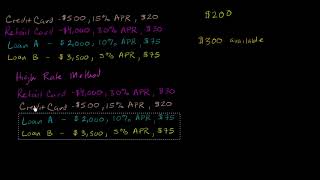
Unit 17: Taxes
What are taxes and why do we pay them
Local taxes
Tax forms
Personal taxes
Unit 18: Insurance
What is risk and how to manage It?
Insurance basics and terminology
Car insurance
Health insurance
Life insurance
Property insurance
Estate planning
Unit 19: Car buying
Owning vs leasing


Unit 20: Housing


Unit 21: Scams & fraud
Personal information and identity

Contracts
Consumer protection agencies
Learn this with a class
With a class on Puzzicle this course runs as a timetable of live study parties: your batch watches together and answers the check-ins, sometimes with a teacher leading.
Course content © Khan Academy, used under CC BY-NC-SA. See this course on Khan Academy.