Macroeconomics
Macroeconomics is about whole economies. What is GDP? Why does the economy boom and bust? How is the government involved? We hit the traditional topics from a college-level macroeconomics course.
8 units172 videos22 hours
Learn it live with a class on Puzzicle · Teachers: use it with your class
Unit 1: Basic economics concepts
Introduction to macroeconomics

Opportunity cost and the Production Possibilities Curve
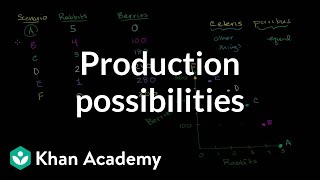
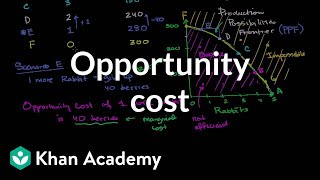
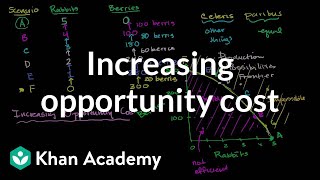
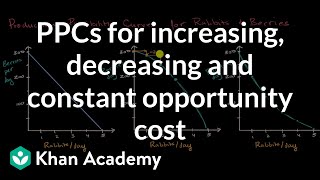
Comparative advantage and the gains from trade
 Comparative advantage, specialization, and gains from trade ✓ Check-ins8:56
 Comparative advantage and absolute advantage ✓ Check-ins10:16
 Opportunity cost and comparative advantage using an output table ✓ Check-ins9:55
 Terms of trade and the gains from trade ✓ Check-ins9:56
 Input approach to determining comparative advantage ✓ Check-ins8:52
 When there aren't gains from trade ✓ Check-ins6:50
 Comparative advantage worked example ✓ Check-ins9:48
Demand
 Law of demand ✓ Check-ins8:16
 Price of related products and demand ✓ Check-ins5:48
 Change in expected future prices and demand ✓ Check-ins4:34
 Changes in income, population, or preferences ✓ Check-ins3:33
 Normal and inferior goods ✓ Check-ins5:56
 Change in demand versus change in quantity demanded ✓ Check-ins8:27
Supply




Unit 2: Economic indicators and the business cycle
Gross Domestic Product
 Circular flow of income and expenditures ✓ Check-ins8:58
 Parsing gross domestic product ✓ Check-ins11:59
 More on final and intermediate GDP contributions ✓ Check-ins2:50
 Investment and consumption ✓ Check-ins7:32
 Income and expenditure views of GDP ✓ Check-ins4:49
 Value added approach to calculating GDP ✓ Check-ins5:16
 Components of GDP ✓ Check-ins4:58
 Expenditure approach to calculating GDP examples ✓ Check-ins8:06
 Examples of accounting for GDP ✓ Check-ins5:57
Limitations of GDP
Unemployment
Inflation

Costs of Inflation
Real vs. nominal GDP
Business cycles

Unit 3: National income and price determination
Multipliers
Short-run aggregate supply
Long-run aggregate supply
Equilibrium in the AD-AS Model
Changes in the AD-AS model in the short run
Long run self-adjustment
Fiscal policy
Automatic stabilizers
Unit 4: Financial sector
Financial assets

Nominal v. real interest rates
Definition, measurement, and functions of money
Banking and the expansion of the money supply
 Overview of fractional reserve banking ✓ Check-ins8:28
 Money creation in a fractional reserve system ✓ Check-ins8:09
 Weaknesses of fractional reserve lending ✓ Check-ins7:34
 Full reserve banking ✓ Check-ins7:32
 Simple fractional reserve accounting (part 1) ✓ Check-ins9:01
 Simple fractional reserve accounting (part 2) ✓ Check-ins7:05
The money market
The market for loanable funds
Interest rates and the time value of money
Unit 5: Long-run consequences of stabilization policies
Fiscal and Monetary Policy Actions in the Short Run
The Phillips curve
Money growth and inflation
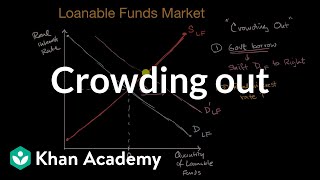
Crowding out
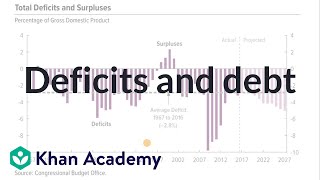
Deficits and debts
Economic growth
Unit 6: Open economy: international trade and finance
The balance of payments
Exchange rates
The foreign exchange market
 Currency exchange introduction ✓ Check-ins12:04
 Supply and demand curves in foreign exchange ✓ Check-ins6:49
 Accumulating foreign currency reserves ✓ Check-ins3:35
 Using reserves to stabilize currency ✓ Check-ins5:09
 Speculative attack on a currency ✓ Check-ins7:49
 Financial crisis in Thailand caused by speculative attack ✓ Check-ins6:33
 Math mechanics of Thai banking crisis ✓ Check-ins7:41
Effect of changes in policies and economic conditions on the foreign exchange market
Real interest rates and international capital flows

Unit 7: Keynesian approaches and IS-LM
The consumption function
The Keynesian cross

IS-LM
Keynesian economics and its critiques

Unit 8: Contemporary macroeconomic issues
Analysis of income inequality in the United States (in partnership with the New York Times)
 Introduction to series analyzing income and wealth trends in the US ✓ Check-ins1:13
 Looking at trends in inflation adjusted income since 1980 ✓ Check-ins5:36
 Comparing income trends across countries ✓ Check-ins5:01
 Per capita GDP trends over past 70 years ✓ Check-ins5:13
 US taxation trends in the post war era ✓ Check-ins4:06
National income and inequality
 Capital by Thomas Piketty ✓ Check-ins3:52
 Difference between wealth and income ✓ Check-ins4:32
 What is capital? ✓ Check-ins9:30
 Piketty's two drivers of divergence ✓ Check-ins9:47
 Is rising inequality necessarily bad? ✓ Check-ins8:32
 Convergence on macro scale ✓ Check-ins3:25
 Education as a force of convergence ✓ Check-ins11:42
 Gilded Age versus Silicon Valley ✓ Check-ins7:11
 Inverse relationship between capital price and returns ✓ Check-ins8:30
 Connecting income to capital growth and potential inequality ✓ Check-ins6:56
 r greater than g but less inequality ✓ Check-ins8:17
 Return on capital and economic growth ✓ Check-ins9:08
 Critically looking at data on ROC and economic growth over millenia ✓ Check-ins5:46
 Simple model to understand r and g relationship ✓ Check-ins7:46
The 2008 Financial Crisis
 CNN: Understanding the crisis ✓ Check-ins14:36
 Bailout 1: Liquidity vs. solvency ✓ Check-ins11:26
 Bailout 2: Book value ✓ Check-ins10:52
 Bailout 3: Book value vs. market value ✓ Check-ins10:32
 Bailout 4: Mark-to-model vs. mark-to-market ✓ Check-ins11:24
 Bailout 5: Paying off the debt ✓ Check-ins10:51
 Bailout 6: Getting an equity infusion ✓ Check-ins12:02
 Bailout 7: Bank goes into bankruptcy ✓ Check-ins10:25
 Bailout 8: Systemic risk ✓ Check-ins11:52
 Bailout 9: Paulson's plan ✓ Check-ins11:05
 Bailout 10: Moral hazard ✓ Check-ins12:07
 Bailout 11: Why these CDOs could be worth nothing ✓ Check-ins10:44
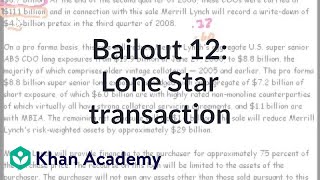 Bailout 12: Lone Star transaction ✓ Check-ins10:28
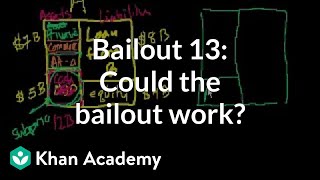 Bailout 13: Does the bailout have a chance of working? ✓ Check-ins10:59
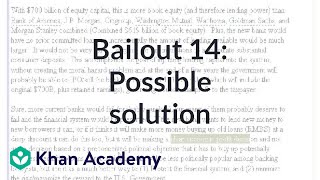 Bailout 14: Possible solution ✓ Check-ins12:22
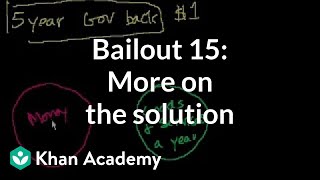 Bailout 15: More on the solution ✓ Check-ins10:09
Learn this with a class
With a class on Puzzicle this course runs as a timetable of live study parties: your batch watches together and answers the check-ins, sometimes with a teacher leading.
Course content © Khan Academy, used under CC BY-NC-SA. See this course on Khan Academy.