AP®︎/College US Government and Politics
Learn AP US Government and Politics: videos, articles, and AP-aligned multiple choice question practice, covering the Constitution, the branches of government, political beliefs, and citizen participation. Review Supreme Court cases, study key amendments, and reflect on how the founders’ intentions and debates continue to influence politics in the Unite States today.
5 units113 videos16 hours
Learn it live with a class on Puzzicle · Teachers: use it with your class
Unit 1: Foundations of American democracy
Ideals of democracy | 1.1
Types of democracy | 1.2
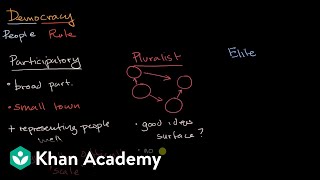
Government power and individual rights | 1.3
Challenges of the Articles of Confederation | 1.4

Ratification of the US Constitution | 1.5
 The Constitutional Convention ✓ Check-ins10:16
 Constitutional compromises: The Electoral College ✓ Check-ins5:32
 Constitutional compromises: The Three-Fifths Compromise ✓ Check-ins6:57
 The impact of constitutional compromises on us today ✓ Check-ins8:26
 Article V of the Constitution: Amendment Process ✓ Check-ins17:12
 Article VI of the Constitution: Debts, Supremacy, Oaths, Religious Tests ✓ Check-ins13:52
 Article VII of the Constitution: Ratification ✓ Check-ins17:13
Principles of American government | 1.6

The relationship between the states and the federal government | 1.7
Constitutional interpretations of federalism | 1.8
 Federal and state powers and the Tenth and Fourteenth Amendments ✓ Check-ins4:41
 The Tenth Amendment ✓ Check-ins16:37
 Enumerated and implied powers of the federal government ✓ Check-ins6:03
 McCulloch v. Maryland | Case facts ✓ Check-ins7:49
 McCulloch v. Maryland ✓ Check-ins19:46
 United States v. Lopez ✓ Check-ins4:59
Federalism in action | 1.9
Unit 2: Interactions among branches of government
Congress: The Senate and the House of Representatives | 2.1
Structures, powers, and functions of Congress | 2.2
 How a bill becomes a law ✓ Check-ins10:37
 The House of Representatives in comparison to the Senate ✓ Check-ins5:22
 Senate filibusters, unanimous consent and cloture ✓ Check-ins6:42
 Discretionary and mandatory outlays of the US federal government ✓ Check-ins6:24
 Earmarks, pork barrel projects and logrolling ✓ Check-ins9:35
Congressional behavior | 2.3
Roles and powers of the president | 2.4
Checks on the presidency | 2.5
Expansion of presidential power | 2.6

Presidential communication | 2.7
The judicial branch | 2.8
The role of the judicial branch | 2.9
The Court in action | 2.10
Checks on the judicial branch | 2.11
 Executive and legislative disagreements with the Supreme Court ✓ Check-ins6:02
 Checks on the judicial branch ✓ Check-ins3:07
 State checks on the judicial branch ✓ Check-ins6:45
 Senate confirmation as a check on the judicial branch ✓ Check-ins3:50
 Judicial activism and judicial restraint ✓ Check-ins8:18
 Increased politicization of the Supreme Court ✓ Check-ins3:48
The bureaucracy | 2.12
Discretionary and rule-making authority | 2.13
Holding the bureaucracy accountable | 2.14
Policy and the branches of government | 2.15

Unit 3: Civil liberties and civil rights
The Bill of Rights | 3.1
The First Amendment: freedom of religion | 3.2
The Second Amendment | 3.5
Balancing individual freedom with public order and safety | 3.6
Selective incorporation | 3.7
Due process and the rights of the accused | 3.8
Due process and the right to privacy | 3.9

Social movements and equal protection | 3.10

Government responses to social movements | 3.11
Balancing minority and majority rights | 3.12
Affirmative action | 3.13
Unit 4: American political ideologies and beliefs
American attitudes about government and politics | 4.1
Political socialization | 4.2
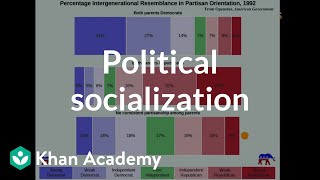
Changes in ideology | 4.3
Influence of political events on ideology | 4.4
Measuring public opinion | 4.5
Evaluating public opinion data | 4.6
Ideologies of political parties | 4.7
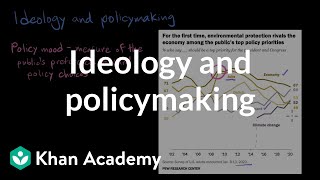
Ideology and policymaking | 4.8
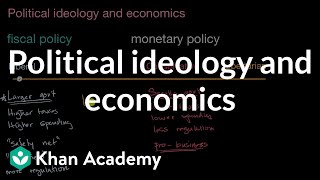
Ideology and economic policy | 4.9
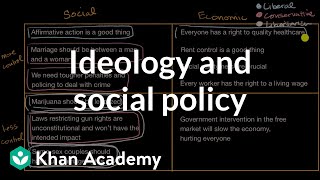
Ideology and social policy | 4.10
Unit 5: Political participation
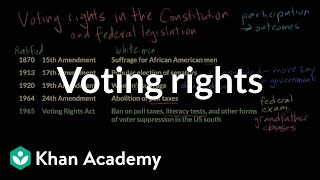
Voting rights and models of voter behavior | 5.1
Voter turnout | 5.2
Political parties | 5.3
How and why political parties change and adapt | 5.4
Third-party politics | 5.5

Interest groups influencing policymaking | 5.6

Groups influencing policy outcomes | 5.7
Electing a president | 5.8
Congressional elections | 5.9
Modern campaigns | 5.10
Campaign finance | 5.11
The media | 5.12

Learn this with a class
With a class on Puzzicle this course runs as a timetable of live study parties: your batch watches together and answers the check-ins, sometimes with a teacher leading.
Course content © Khan Academy, used under CC BY-NC-SA. See this course on Khan Academy.