AP®︎/College US History
Learn AP US History: key concepts, themes, and periods from the pre-contact era right up to the present, all designed for learners preparing for the AP US History exam. Expand your knowledge of the United States's rich history, and review your learning using our AP-aligned practice questions.
10 units127 videos21 hours
Learn it live with a class on Puzzicle · Teachers: use it with your class
Unit 1: Period 1: 1491-1607
Thinking like a historian
 Meet Kim, one of the creators of Khan Academy's AP US History lessons ✓ Check-ins1:45
 Thinking like a historian ✓ Check-ins8:48
 How to read a document: Source identification ✓ Check-ins12:35
 How to read a document: Analyzing a historical text ✓ Check-ins13:49
 Avoiding common mistakes in historical essays ✓ Check-ins9:45
Native American societies before contact | 1.2

European exploration in the Americas | 1.3

Columbian Exchange, Spanish exploration, and conquest | 1.4

Labor, slavery, and caste in the Spanish colonial system | 1.5

Cultural interactions between Europeans, Native Americans, and Africans | 1.6

Causation in Period 1 | 1.7

Unit 2: Period 2: 1607-1754
European colonization | 2.2



Regions of British colonies | 2.3
 Early English settlements - Jamestown ✓ Check-ins4:56
 Early interactions with Native Americans ✓ Check-ins6:08
 The impact of tobacco ✓ Check-ins4:36
 Life and labor in the Chesapeake ✓ Check-ins7:37
 Bacon's Rebellion ✓ Check-ins12:20
 Society and religion in the New England colonies ✓ Check-ins11:07
 The Middle colonies ✓ Check-ins10:33
 The West Indies and the Southern colonies ✓ Check-ins11:57
Interactions between American Indians and Europeans | 2.5

Slavery in the British colonies | 2.6

Comparison in Period 2 | 2.8
Unit 3: Period 3: 1754-1800
The Seven Years' War (The French and Indian War) | 3.2

Philosophical foundations of the American Revolution | 3.4
The influence of revolutionary ideals | 3.6

The Articles of Confederation | 3.7

The Constitutional Convention and debates over ratification | 3.8
The Constitution | 3.9

Movement in the early republic | 3.12
Continuity and change in Period 3 | 3.13

Unit 4: Period 4: 1800-1848
America on the world stage | 4.4

Market Revolution: industrialization | 4.5

Market Revolution: society and culture | 4.6

Jackson and federal power | 4.8
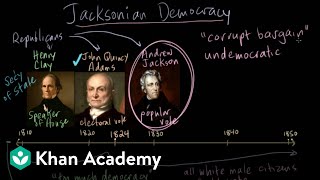
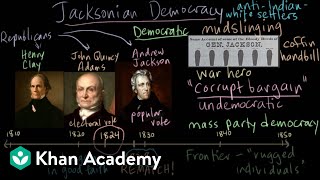

The development of an American culture | 4.9

The Second Great Awakening | 4.10
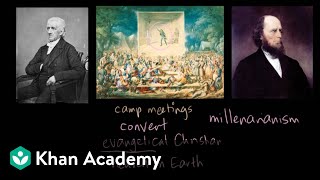
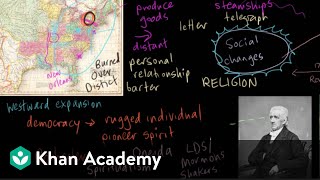

An age of reform | 4.11
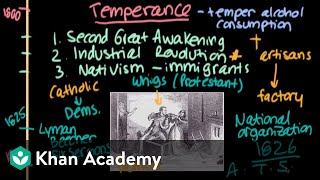
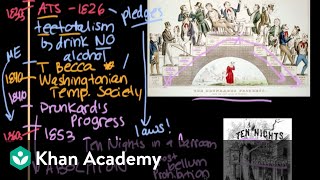
Causation in Period 4 | 4.14
Unit 5: Period 5: 1844-1877
Manifest Destiny | 5.2

The Mexican-American War | 5.3

The Compromise of 1850 | 5.4
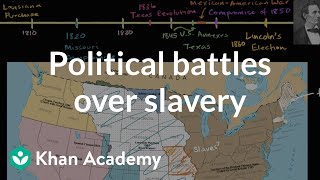
Sectional conflict: regional differences | 5.5


Failure of compromise | 5.6

Election of 1860 and secession | 5.7
Military conflict in the Civil War | 5.8
 Strategy of the Civil War ✓ Check-ins11:03
 Early phases of Civil War and Antietam ✓ Check-ins10:17
 Significance of the battle of Antietam ✓ Check-ins7:21
 The battle of Gettysburg ✓ Check-ins12:17
 The Anaconda Plan ✓ Check-ins5:51
 The election of 1864 and Sherman's March ✓ Check-ins8:50
 Appomattox and Lincoln's assassination ✓ Check-ins10:38
Government policies during the Civil War | 5.9


Reconstruction | 5.10
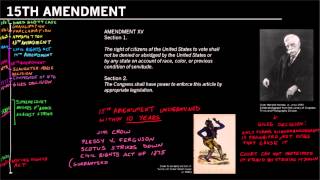
Failure of Reconstruction | 5.11

Unit 6: Period 6: 1865-1898
Westward expansion: social and cultural development | 6.3

The "New South" | 6.4

Technological innovation | 6.5


The rise of industrial capitalism | 6.6

Immigration and migration in the Gilded Age | 6.8

Responses to immigration in the Gilded Age | 6.9
Reform in the Gilded Age | 6.11

Continuity and change in Period 6 | 6.14
Unit 7: Period 7: 1890-1945
Imperialism: debates | 7.2
The Progressives | 7.4
World War I: military and diplomacy | 7.5
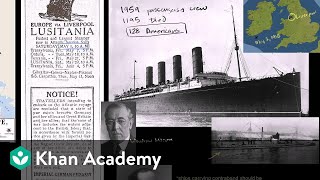 Blockades, u-boats and sinking of the Lusitania ✓ Check-ins12:04
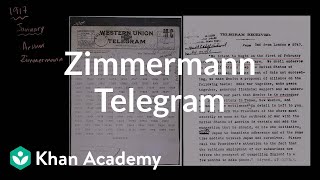 Zimmermann Telegram ✓ Check-ins4:10
 United States enters World War I ✓ Check-ins7:05
 Woodrow Wilson's Fourteen Points ✓ Check-ins16:36
 Paris Peace Conference and Treaty of Versailles ✓ Check-ins10:10
 More detail on the Treaty of Versailles and Germany ✓ Check-ins6:20
World War I: home front | 7.6

1920s: cultural and political controversies | 7.8

Interwar foreign policy | 7.11


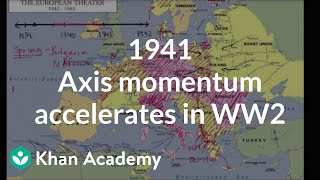
World War II: military | 7.13
 1942 - Tide turning in World War II in Europe ✓ Check-ins5:12
 World War II in the Pacific ✓ Check-ins5:51
 1943 - Axis powers losing in Europe ✓ Check-ins4:56
 American progress in the Pacific in 1944 ✓ Check-ins7:35
 1944 - Allies advance further in Europe ✓ Check-ins6:25
 End of World War II ✓ Check-ins8:04
Comparison in Period 7 | 7.15

Unit 8: Period 8: 1945-1980
The Cold War from 1945 to 1980 | 8.2


America as a world power | 8.7


The Vietnam War | 8.8

Continuity and change in Period 8 | 8.15

Unit 9: Period 9: 1980-present
Causation in Period 9 | 9.7
Unit 10: AP®︎ U.S. History exam skills and strategies
AP®︎ U.S. History worked examples
 AP US History multiple choice example 1 ✓ Check-ins11:51
 AP US History multiple choice example 2 ✓ Check-ins5:03
 AP US History short answer example 1 ✓ Check-ins7:14
 AP US History short answer example 2 ✓ Check-ins4:21
 Preparing for the AP US History Exam (5/4/2016) ✓ Check-ins72:28
 AP US History Exam Prep Session (5/1/2017) ✓ Check-ins62:43
Learn this with a class
With a class on Puzzicle this course runs as a timetable of live study parties: your batch watches together and answers the check-ins, sometimes with a teacher leading.
Course content © Khan Academy, used under CC BY-NC-SA. See this course on Khan Academy.