3rd grade (Eureka Math Squared-aligned)
This course contains Khan Academy practice problems crafted to support the Eureka Math Squared (EM2) curriculum. Designed to make it easier for districts, teachers, and students to find and use practice problems that complement EM2 lessons, this course was not produced in official partnership with Eureka Math Squared.
6 units184 videos11 hours
Learn it live with a class on Puzzicle · Teachers: use it with your class
Unit 1: Multiplication and division with units of 2, 3, 4, 5, and 10
Organize, count, and represent a collection of objects
Interpret equal groups as multiplication
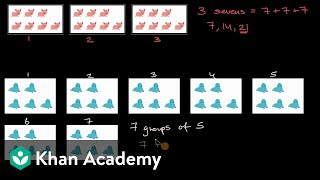
Relate multiplication to the array model
Interpret the meaning of factors as numbers of groups or number in each group
Represent and solve multiplication word problems by using drawings and equations
Model measurement and partitive division by drawing equal groups
Model measurement and partitive division by drawing arrays
Represent and solve division word problems using drawings and equations
Demonstrate the distributive property using a unit of 4
Demonstrate the commutative property of multiplication using a unit of 3 and the array model
Model division as an unknown factor problem
Model the quotient as the number of groups using units of 2, 3, 4, 5, and 10
Model the quotient as the size of each group using units of 2, 3, 4, 5, and 10
Represent and solve measurement and partitive division word problems
Represent and solve two-step word problems using the properties of multiplication
Represent and solve two-step word problems using drawings and equations
Unit 2: Place value concepts through metric measurement
Connect the composition of 1 kilogram to the composition of 1 thousand
Estimate the weight of familiar objects and read scaled when weighing objects

Use all four operations to solve one- step word problems involving weight
Connect decomposition of 1 liter to the decomposition of 1 thousand

Use all four operations to solve one- step word problems involving liquid volume
Round to the nearest hundred on the vertical number line
Estimate sums and differences by rounding
Collect and represent data in a scaled bar graph and solve related problems
 Picture graphs ✓ Check-ins2:48
 Understanding picture and bar graphs ✓ Check-ins3:45
 Asking questions about data in a graph ✓ Check-ins2:15
 Creating a bar graph ✓ Check-ins1:07
 Reading bar graphs: movies ✓ Check-ins3:49
 Reading bar graphs: bikes ✓ Check-ins1:43
 Interpreting bar graphs: colors ✓ Check-ins4:05
Use place value understanding to add and subtract like units
 Breaking apart 3-digit addition problems ✓ Check-ins3:42
 Adding 10 or 100 ✓ Check-ins3:59
 Adding 1s, 10s, and 100s ✓ Check-ins3:37
 Subtraction by breaking apart ✓ Check-ins3:30
 Subtracting 1, 10, or 100 ✓ Check-ins4:11
 Subtracting 1s, 10s, and 100s ✓ Check-ins3:12
 Subtracting 3-digit numbers (no regrouping) ✓ Check-ins2:57
 Adding and subtracting on number line ✓ Check-ins2:25
Use the associative property to make the next ten to add
Add measurement using the standard algorithm to compose larger units twice
Subtract measurements using the standard algorithm to compose larger units once
Subtract measurements using the standard algorithm to decompose larger across two place values
 Worked example: Subtracting 3-digit numbers (regrouping) ✓ Check-ins2:47
 Subtracting 3-digit numbers (regrouping) ✓ Check-ins3:20
 Worked example: Subtracting 3-digit numbers (regrouping twice) ✓ Check-ins3:48
 Worked example: Subtracting 3-digit numbers (regrouping from 0) ✓ Check-ins2:24
 Understanding the standard algorithm when subtracting within 1,000 ✓ Check-ins2:24
Unit 3: Multiplication and division with units of 0, 1, 6, 7, 8, and 9
Decompose pictorial arrays to create expressions with three factors
Model the associative property as a strategy to multiply
Use parentheses in expressions with different operations
Identify patterns by using the multiplication table
 Finding patterns in a multiplication table ✓ Check-ins1:35
 Using multiplication strategies to find products ✓ Check-ins2:00
 Finding patterns in numbers ✓ Check-ins3:37
 Recognizing number patterns ✓ Check-ins2:29
 Intro to even and odd numbers ✓ Check-ins7:30
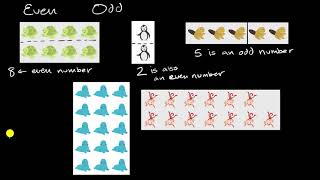 Understanding even and odd numbers visually ✓ Check-ins4:28
 Patterns with multiplying even and odd numbers ✓ Check-ins3:15
 Patterns in hundreds chart ✓ Check-ins4:04
 Patterns in multiplication tables ✓ Check-ins5:16
Identify and complete patterns with input–output tables
Create multiplication and division word problems
Solve two-step word problems by using the four operations and assess the reasonableness of solutions
Multiply by multiples of 10 by using the place value chart
Multiply by multiples of 10 by using place value strategies and the associative property
Solve two-step word problems involving multiplication of single-digit factors and multiples of 10
Unit 4: Multiplication and area
Explore attributes of squares, rectangles, and trapezoids
Tile polygons to find their areas
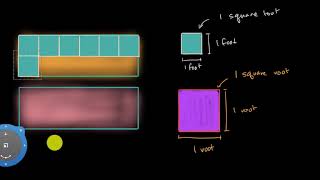
Relate side lengths to the number of tiles on a side
Draw rows and columns to complete a rectangular array and determine its area
Determine the area of a rectangle by using side lengths

Multiply side lengths to find the area of a rectangle
Compose large rectangles and reason about their areas
Decompose to find the total area of a rectangle
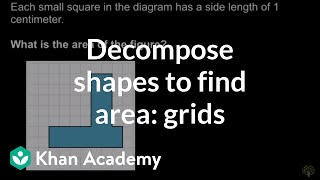
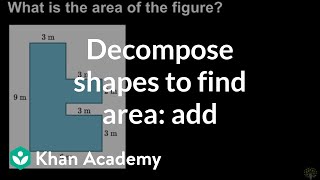
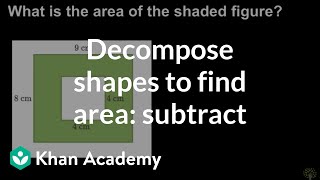
Apply area understanding to real-world situations
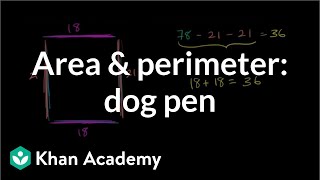
Apply area concepts to a real-world context
Unit 5: Fractions as numbers
Partition a whole into equal parts and name the fractional unit
Partition different wholes into fractional units concretely
Partition a whole into fractional units and write fractions in fraction form
Build non-unit fractions less than 1 from unit fractions concretely
Identify and represent a whole as two non-unit fractions
Compare unit fractions by reasoning about their size concretely
Locate fractions from 0 to 1 on a number line by using fraction tiles
Represent fractions from 0 to 1 on a number line
Identify equivalent fractions from 0 to 1 with tape diagrams and on number lines
Recognize that equivalent fractions share the same location on a number line
Identify fractions on a ruler as numbers on a number line
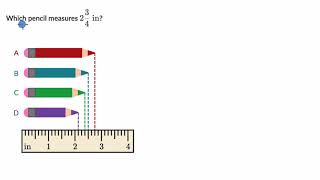
Measure lengths and record data on a line plot
Represent fractions greater than 1 on a number line and identify fractions equivalent to whole numbers
Compare fractions with like units by using a number line
Compare fractions with unlike units but the same numerator by using number lines
Compare fractions with related units by using a number line
Generate equivalent fractions greater than 1 by using a number line
Express whole numbers as fractions with a denominator of 1
Unit 6: Geometry, measurement, and data
Relate skip-counting by fives on the clock to telling time on the number line
Count by fives and ones on the number line as a strategy for telling time to the nearest minute on the clock
Solve time word problems where the change in time is unknown
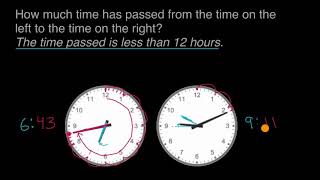
Solve time word problems and use time data to create a line plot
Count coins and create money word problems (optional)
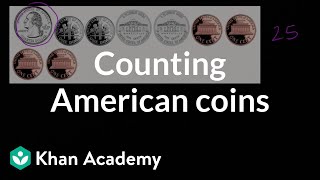
Decompose quadrilaterals to understand perimeter as the boundary of a shape
Recognize perimeter as an attribute of shapes and solve problems with unknown measurements
Solve problems to determine the perimeters of rectangles with the same area
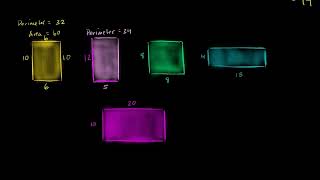
Solve problems to determine the areas of rectangles with the same perimeter
Solve real-world problems involving perimeter and unknown measurements by using all four operations
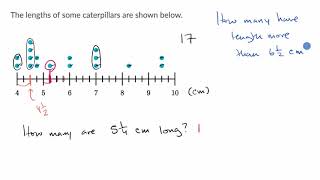
Record measurement data in a line plot
Solve problems by creating scaled picture graphs and scaled bar graphs
Fluently multiply and divide within 100 and add and subtract within 1,000
 Multiplying 2 digit by 1 digit numbers within 100 ✓ Check-ins2:07
 Partial products for multiplying 2 by 1 digits ✓ Check-ins1:15
 Distributive property for multiplying two digits by one digit ✓ Check-ins2:08
 Multiplying 2-digit by 1-digit word problems ✓ Check-ins2:19
 Adding 3-digit numbers ✓ Check-ins3:04
 Subtracting with place value blocks (regrouping) ✓ Check-ins2:29
Learn this with a class
With a class on Puzzicle this course runs as a timetable of live study parties: your batch watches together and answers the check-ins, sometimes with a teacher leading.
Course content © Khan Academy, used under CC BY-NC-SA. See this course on Khan Academy.