Algebra 1 (IM® v.360 aligned)
This course contains Khan Academy practice problems crafted to support the IM® v.360 curriculum by Illustrative Mathematics® (IM), licensed under Creative Commons/Attribution/Non-commercial 4.0. Designed to make it easier for districts, teachers, and students to find and use practice problems that complement IM v.360 lessons, this course was not produced in official partnership with Illustrative Mathematics.
8 units322 videos27 hours
Learn it live with a class on Puzzicle · Teachers: use it with your class
Unit 1: One-variable statistics
Getting to know you
Data representations (Optional)
 Representing data ✓ Check-ins8:18
 Frequency tables & dot plots ✓ Check-ins7:19
 Creating a histogram ✓ Check-ins7:22
 Interpreting a histogram ✓ Check-ins4:29
 Reading box plots ✓ Check-ins3:18
 Constructing a box plot ✓ Check-ins8:18
 Worked example: Creating a box plot (odd number of data points) ✓ Check-ins3:18
 Worked example: Creating a box plot (even number of data points) ✓ Check-ins3:15
A gallery of data
The shape of distributions
Calculating measures of center & variability (optional)
The effect of extremes
Comparing & contrasting data distributions
Standard deviation
More standard deviation
Comparing data sets
Unit 2: Linear equations and systems
Planning a party
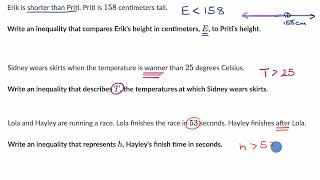
Writing equations to model relationships (part 1) (optional)
Writing equations to model relationships (part 2) (optional)
Equations and their solutions (optional)
Equations and their graphs (optional)
Explaining steps for rewriting equations
Which variable to solve for? (part 1)
Which variable to solve for? (part 2)
Connecting equations to graphs (part 1)
 Intro to intercepts ✓ Check-ins6:33
 x-intercept of a line ✓ Check-ins1:43
 Intercepts from an equation ✓ Check-ins4:08
 Intro to linear equation standard form ✓ Check-ins8:07
 Graphing a linear equation: 5x+2y=20 ✓ Check-ins4:29
 Interpreting linear equations in different forms ✓ Check-ins ✎ Fixed a slip5:01
 Slope, x-intercept, y-intercept meaning in context ✓ Check-ins4:00
 Linear graphs word problem: cats ✓ Check-ins2:43
Connecting equations to graphs (part 2)
Writing & graphing systems of linear equations
 Systems of equations: trolls, tolls (1 of 2) ✓ Check-ins6:51
 Systems of equations: trolls, tolls (2 of 2) ✓ Check-ins5:41
 Testing a solution to a system of equations ✓ Check-ins2:38
 Systems of equations with graphing: y=7/5x-5 & y=3/5x-1 ✓ Check-ins2:22
 Systems of equations with graphing: exact & approximate solutions ✓ Check-ins5:56
 Setting up a system of equations from context example (pet weights) ✓ Check-ins1:59
 Setting up a system of linear equations example (weight and price) ✓ Check-ins4:12
 Interpreting points in context of graphs of systems ✓ Check-ins5:39
Solving systems by substitution
Solving systems by elimination (part 1)
Solving systems by elimination (part 2)

Solving systems by elimination (part 3)
Systems of linear equations and their solutions
Unit 3: Two-variable statistics
Relative frequency tables
Associations in categorical data
Linear models
 Bivariate relationship linearity, strength and direction ✓ Check-ins8:13
 Estimating the line of best fit exercise ✓ Check-ins1:17
 Fitting a line to data ✓ Check-ins7:48
 Line of best fit: smoking in 1945 ✓ Check-ins4:47
 Estimating with linear regression (linear models) ✓ Check-ins3:23
 Interpreting slope of regression line ✓ Check-ins2:58
 Interpreting y-intercept in regression model ✓ Check-ins2:36
Residuals
The correlation coefficient
Unit 4: Linear inequalities and systems
Representing situations with inequalities
Writing & solving inequalities in one variable
Graphing linear inequalities in two variables (part 1)
Graphing linear inequalities in two variables (part 2)
Solving problems with inequalities in two variables
Solutions to systems of linear inequalities in two variables
Solving problems with systems of linear inequalities in two variables
Unit 5: Functions
Describing & graphing situations
 Testing if a relationship is a function ✓ Check-ins2:23
 Relations and functions ✓ Check-ins6:57
 Recognizing functions from graph ✓ Check-ins4:07
 Checking if a table represents a function ✓ Check-ins1:16
 Recognizing functions from table ✓ Check-ins4:40
 Checking if an equation represents a function ✓ Check-ins3:33
 Does a vertical line represent a function? ✓ Check-ins1:40
 Recognizing functions from verbal description ✓ Check-ins1:31
 Recognizing functions from verbal description word problems ✓ Check-ins3:23
 Dependent & independent variables ✓ Check-ins2:19
 Interpreting a graph example ✓ Check-ins2:23
Function notation
Interpreting & using function notation
 What is a function? ✓ Check-ins7:57
 Function notation example ✓ Check-ins2:13
 Worked example: Evaluating functions from graph ✓ Check-ins0:44
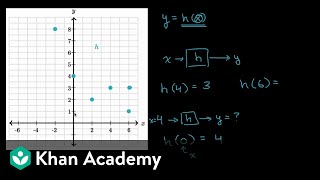 Evaluating discrete functions ✓ Check-ins3:20
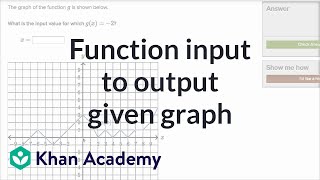 Worked example: matching an input to a function's output (graph) ✓ Check-ins1:07
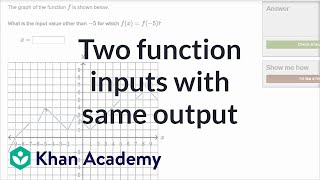 Worked example: two inputs with the same output (graph) ✓ Check-ins1:48
Using function notation to describe rules (part 1)
Using function notation to describe rules (part 2)
Features of graphs
 Introducing minimum and maximum points ✓ Check-ins5:30
 Worked example: absolute and relative extrema ✓ Check-ins4:58
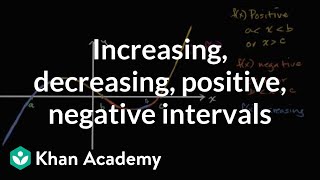 Increasing, decreasing, positive or negative intervals ✓ Check-ins5:56
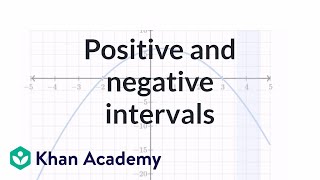 Worked example: positive & negative intervals ✓ Check-ins1:10
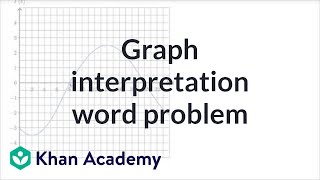 Graph interpretation word problem: temperature ✓ Check-ins3:55
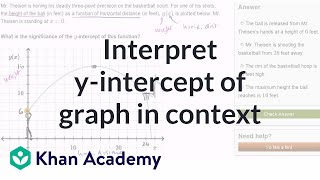 Graph interpretation word problem: basketball ✓ Check-ins3:50
Using graphs to find average rate of change
Interpreting and creating graphs
Comparing graphs
Domain & range (part 1)
 Intervals and interval notation ✓ Check-ins9:36
 What is the domain of a function? ✓ Check-ins6:45
 What is the range of a function? ✓ Check-ins6:39
 Worked example: domain and range from graph ✓ Check-ins3:34
 Determining whether values are in domain of function ✓ Check-ins4:57
 Examples finding the domain of functions ✓ Check-ins4:25
 Worked example: determining domain word problem (real numbers) ✓ Check-ins2:19
 Worked example: determining domain word problem (positive integers) ✓ Check-ins2:34
 Worked example: determining domain word problem (all integers) ✓ Check-ins5:34
Domain & range (part 2)
Piecewise functions
 Introduction to piecewise functions ✓ Check-ins3:49
 Worked example: evaluating piecewise functions ✓ Check-ins4:24
 Interpreting a piecewise function graph ✓ Check-ins2:08
 Worked example: graphing piecewise functions ✓ Check-ins4:30
 Worked example: domain & range of step function ✓ Check-ins2:44
 Worked example: domain & range of piecewise linear functions ✓ Check-ins7:25
Absolute value functions (part 1)
Absolute value functions (part 2)
Inverse functions

Finding and interpreting inverse functions
Writing inverse functions to solve problems
Using functions to model battery power
Unit 6: Introduction to exponential functions
Growing and growing
Patterns of growth
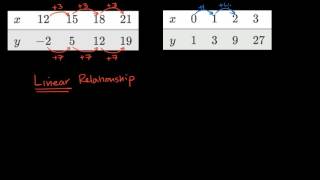
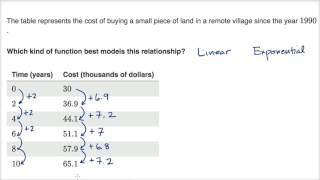
Representing exponential growth
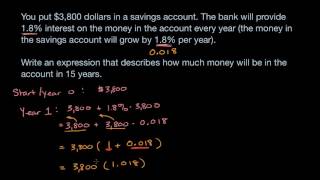 Exponential expressions word problems (numerical) ✓ Check-ins4:56
 The zeroth power ✓ Check-ins4:32
 Initial value & common ratio of exponential functions ✓ Check-ins5:27
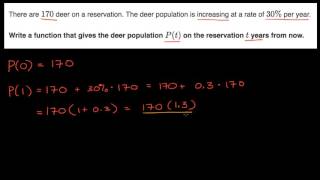 Exponential expressions word problems (algebraic) ✓ Check-ins3:36
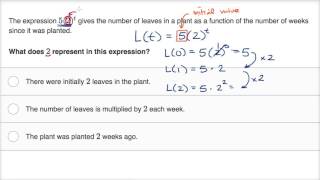 Interpreting exponential expression word problem ✓ Check-ins2:45
 Exponential function graph ✓ Check-ins5:32
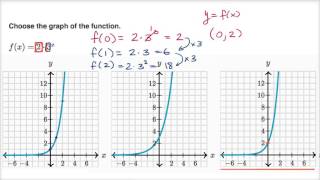 Graphs of exponential growth ✓ Check-ins4:21
Representing exponential decay
Understanding decay
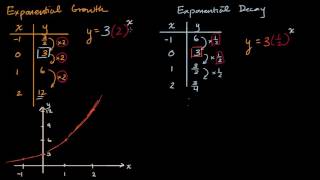
Analyzing graphs
 Writing exponential functions ✓ Check-ins1:40
 Writing exponential functions from tables ✓ Check-ins5:17
 Writing exponential functions from graphs ✓ Check-ins7:25
 Analyzing tables of exponential functions ✓ Check-ins7:20
 Analyzing graphs of exponential functions ✓ Check-ins4:06
 Analyzing graphs of exponential functions: negative initial value ✓ Check-ins6:07
 Modeling with basic exponential functions word problem ✓ Check-ins5:37
 Modeling car value over time with exponential decay ✓ Check-ins2:32
Using negative exponents
Exponential situations as functions
Interpreting exponential functions
Looking at rates of change
Modeling exponential behavior
Reasoning about exponential graphs (part 1)
Reasoning about exponential graphs (part 2) (optional)
Functions involving percent change
Compounding interest
Different compounding intervals
Expressed in different ways
Which one changes faster?
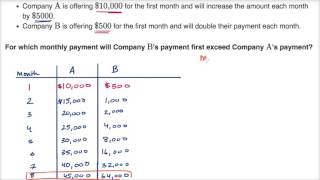
Changes over equal intervals
Predicting populations
Unit 7: Introduction to quadratic functions
A different kind of change
How does it change?
Building quadratic functions from geometric patterns
Comparing quadratic and exponential functions
Building quadratic functions to describe situations (part 1)
Building quadratic functions to describe situations (part 2)
Building quadratic functions to describe situations (part 3)
Equivalent quadratic expressions
Standard form and factored form
Graphs of functions in standard and factored forms
Graphing from the factored form
Graphs that represent situations (optional)

Vertex form
Graphing from the vertex form (optional)
Unit 8: Quadratic equations
Finding unknown inputs
Solving quadratic equations by reasoning
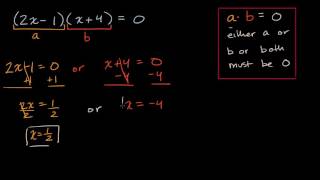
Solving quadratic equations with the zero product property
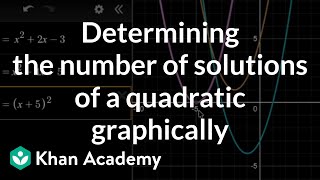
How many solutions?
Rewriting quadratic expressions in factored form (part 1)
Rewriting quadratic expressions in factored form (part 2)
Rewriting quadratic expressions in factored form (part 3)
 Special products of the form (x+a)(x-a) ✓ Check-ins4:54
 Special products of the form (ax+b)(ax-b) ✓ Check-ins2:29
 Difference of squares intro ✓ Check-ins4:54
 Factoring difference of squares: leading coefficient ≠ 1 ✓ Check-ins2:23
 Factoring difference of squares: analyzing factorization ✓ Check-ins3:09
 Factoring difference of squares: shared factors ✓ Check-ins4:23
Solving quadratic equations by using factored form
Rewriting quadratic expressions in factored form (part 4)
 Intro to grouping ✓ Check-ins13:57
 Factoring quadratics by grouping ✓ Check-ins3:55
 Factoring quadratics: common factor + grouping ✓ Check-ins4:46
 Factoring quadratics: negative common factor + grouping ✓ Check-ins5:17
 Solving quadratics by factoring: leading coefficient ≠ 1 ✓ Check-ins4:35
 Quadratic equations word problem: box dimensions ✓ Check-ins5:54
 Quadratic equations word problem: triangle dimensions ✓ Check-ins8:21
What are perfect squares?
Completing the square (part 1)
 Perfect square factorization intro ✓ Check-ins5:19
 Completing the square ✓ Check-ins14:06
 Worked example: Completing the square (intro) ✓ Check-ins3:22
 Worked example: Rewriting expressions by completing the square ✓ Check-ins3:02
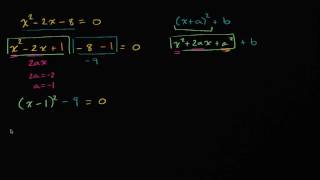 Worked example: Rewriting & solving equations by completing the square ✓ Check-ins6:19
 Solve by completing the square: Integer solutions ✓ Check-ins6:29
Completing the square (part 2)
Completing the square (part 3)
 Factoring perfect squares ✓ Check-ins4:54
 Identifying perfect square form ✓ Check-ins4:37
 Factoring perfect squares: negative common factor ✓ Check-ins3:52
 Factoring perfect squares: missing values ✓ Check-ins2:39
 Factoring perfect squares: shared factors ✓ Check-ins4:26
 Worked example: completing the square (leading coefficient ≠ 1) ✓ Check-ins5:44
 Solving quadratics by completing the square: no solution ✓ Check-ins5:24
Quadratic equations with irrational solutions
The quadratic formula
Applying the quadratic formula (part 1)
Applying the quadratic formula (part 2) (optional)
Deriving the quadratic formula
Rational & irrational solutions
Sums & products of rational & irrational numbers
 Proof: sum & product of two rationals is rational ✓ Check-ins2:46
 Proof: product of rational & irrational is irrational ✓ Check-ins3:15
 Proof: sum of rational & irrational is irrational ✓ Check-ins3:24
 Sums and products of irrational numbers ✓ Check-ins5:57
 Worked example: rational vs. irrational expressions ✓ Check-ins2:36
 Worked example: rational vs. irrational expressions (unknowns) ✓ Check-ins6:26
Rewriting quadratic expressions in vertex form
 Rewriting a quadratic function from vertex form to standard form ✓ Check-ins2:50
 Forms & features of quadratic functions ✓ Check-ins8:29
 Worked examples: Forms & features of quadratic functions ✓ Check-ins6:42
 Vertex & axis of symmetry of a parabola ✓ Check-ins7:22
 Finding features of quadratic functions ✓ Check-ins8:23
Using quadratic expressions in vertex form to solve problems
Using quadratic equations to model situations and solve problems
Learn this with a class
With a class on Puzzicle this course runs as a timetable of live study parties: your batch watches together and answers the check-ins, sometimes with a teacher leading.
Course content © Khan Academy, used under CC BY-NC-SA. See this course on Khan Academy.