Precalculus (Eureka Math/EngageNY)
Learn Precalculus aligned to the Eureka Math/EngageNY curriculum —complex numbers, vectors, matrices, and more.
5 units229 videos25 hours
Learn it live with a class on Puzzicle · Teachers: use it with your class
Unit 1: Module 1: Complex numbers and transformations
Topic A: Lessons 1-6: Complex numbers review
Topic A: Lessons 7-8: Complex number division
Topic B: Lessons 9-12: Distance and midpoint of complex numbers
Topic B: Lesson 13: Trigonometry and complex numbers
Topic B: Lessons 14-17: Multiplying and dividing complex numbers in polar form
Topic C: Lessons 18-19: Exploiting the connection to trigonometry
Topic C: Lessons 21-23: Transforming vectors with matrices
Topic C: Lesson 24: Matrix notation encompasses new transformations!
Topic C: Lesson 25: Properties of matrix addition
Topic C: Lesson 25: Properties of matrix multiplication
Unit 2: Module 2: Vectors and matrices
Topic A: Networks and matrices
Topic C: Systems of linear equations
Topic D: Lessons 17-18: Vectors in the coordinate plane
 Intro to vectors and scalars ✓ Check-ins8:39
 Recognizing vectors ✓ Check-ins2:36
 Equivalent vectors ✓ Check-ins6:37
 Vector magnitude from graph ✓ Check-ins3:38
 Vector magnitude from components ✓ Check-ins3:06
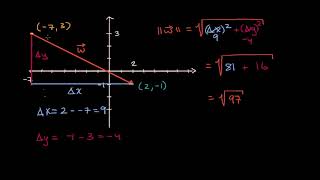 Vector magnitude from initial & terminal points ✓ Check-ins5:23
 Scalar multiplication: component form ✓ Check-ins5:42
 Adding & subtracting vectors ✓ Check-ins7:42
Topic D: Lesson 19: Directed line segments and vectors
 Finding the components of a vector ✓ Check-ins3:18
 Comparing the components of vectors ✓ Check-ins2:55
 Scalar multiplication: magnitude and direction ✓ Check-ins4:53
 Adding & subtracting vectors end-to-end ✓ Check-ins6:22
 Subtracting vectors end-to-end ✓ Check-ins1:44
 Adding vectors algebraically & graphically ✓ Check-ins7:12
 Combined vector operations ✓ Check-ins5:59
Topic D: Lessons 20: Vectors and stone bridges
 Direction of vectors from components: 1st & 2nd quadrants ✓ Check-ins9:01
 Direction of vectors from components: 3rd & 4th quadrants ✓ Check-ins6:42
 Vector components from magnitude & direction ✓ Check-ins10:16
 Adding vectors in magnitude & direction form (1 of 2) ✓ Check-ins9:22
 Adding vectors in magnitude & direction form (2 of 2) ✓ Check-ins ✎ Fixed a slip8:07
 Vector addition & magnitude ✓ Check-ins5:30
Topic D: Lessons 23-24: Why are vectors useful?
Topic E: First-person video games—projection matrices
Unit 3: Module 3: Rational and exponential functions
Topic A: Lesson 1: Solutions to polynomial equations
 Factoring higher-degree polynomials ✓ Check-ins8:02
 Factoring sum of cubes ✓ Check-ins4:46
 Factoring difference of cubes ✓ Check-ins4:12
 Complex numbers & sum of squares factorization ✓ Check-ins4:51
 Factoring sum of squares ✓ Check-ins2:32
 Finding zeros of polynomials (1 of 2) ✓ Check-ins9:09
 Finding zeros of polynomials (2 of 2) ✓ Check-ins3:00
 Finding zeros of polynomials (example 2) ✓ Check-ins ✎ Fixed a slip6:45
Topic A: Lessons 2-3: Roots of complex numbers
Topic A: Lessons 4-5: The binomial theorem
Topic A: Lessons 6-7: Ellipses
Topic A: Lesson 8: Hyperbolas
 Intro to hyperbolas ✓ Check-ins13:34
 Vertices & direction of a hyperbola ✓ Check-ins5:15
 Vertices & direction of a hyperbola (example 2) ✓ Check-ins2:21
 Foci of a hyperbola from equation ✓ Check-ins15:24
 Proof of the hyperbola foci formula ✓ Check-ins14:50
 Equation of a hyperbola not centered at the origin ✓ Check-ins10:29
Topic A: Lesson 9: Volume and Cavalieri’s principle
Topic B: Lessons 10-11: Simplifying rational expressions
 Reducing rational expressions to lowest terms ✓ Check-ins15:22
 Simplifying rational expressions: common monomial factors ✓ Check-ins6:59
 Simplifying rational expressions: common binomial factors ✓ Check-ins4:11
 Simplifying rational expressions: opposite common binomial factors ✓ Check-ins3:53
 Simplifying rational expressions: grouping ✓ Check-ins6:42
 Simplifying rational expressions: higher degree terms ✓ Check-ins5:53
 Simplifying rational expressions: two variables ✓ Check-ins6:11
Topic B: Lessons 10-11: Multiplying & dividing rational expressions
 Multiplying & dividing rational expressions: monomials ✓ Check-ins5:56
 Multiplying rational expressions ✓ Check-ins4:52
 Dividing rational expressions ✓ Check-ins ✎ Fixed a slip4:10
 Multiplying rational expressions: multiple variables ✓ Check-ins3:38
 Dividing rational expressions: unknown expression ✓ Check-ins6:02
Topic B: Lessons 10-11: Adding & subtracting rational expressions
 Adding & subtracting rational expressions: like denominators ✓ Check-ins3:45
 Intro to adding rational expressions with unlike denominators ✓ Check-ins2:44
 Adding rational expression: unlike denominators ✓ Check-ins5:11
 Subtracting rational expressions: unlike denominators ✓ Check-ins4:47
 Least common multiple ✓ Check-ins4:16
 Least common multiple: repeating factors ✓ Check-ins2:35
 Subtracting rational expressions: factored denominators ✓ Check-ins4:48
 Least common multiple of polynomials ✓ Check-ins6:52
 Subtracting rational expressions ✓ Check-ins4:36
 Nested fractions ✓ Check-ins5:46
Topic B: Lessons 12-13: End behavior and asymptotes of rational functions
Topic B: Lessons 14-15: Graphing rational functions
 Graphing rational functions according to asymptotes ✓ Check-ins11:22
 Graphs of rational functions: y-intercept ✓ Check-ins3:08
 Graphs of rational functions: horizontal asymptote ✓ Check-ins3:16
 Graphs of rational functions: vertical asymptotes ✓ Check-ins5:33
 Graphs of rational functions: zeros ✓ Check-ins7:47
 Graphing rational functions 1 ✓ Check-ins ✎ Fixed a slip11:04
 Graphing rational functions 2 ✓ Check-ins ✎ Fixed a slip8:20
 Graphing rational functions 3 ✓ Check-ins ✎ Fixed a slip21:06
 Graphing rational functions 4 ✓ Check-ins ✎ Fixed a slip11:31
 Intro to long division of polynomials ✓ Check-ins12:09
Topic B: Lessons 16-17: Function composition
 Intro to composing functions ✓ Check-ins6:15
 Evaluating composite functions ✓ Check-ins4:10
 Evaluating composite functions: using tables ✓ Check-ins4:10
 Evaluating composite functions: using graphs ✓ Check-ins3:02
 Finding composite functions ✓ Check-ins2:57
 Evaluating composite functions (advanced) ✓ Check-ins4:11
 Modeling with composite functions ✓ Check-ins6:43
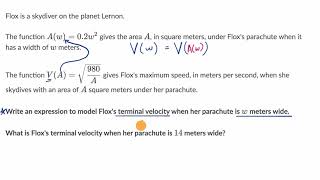 Modeling with composite functions: skydiving ✓ Check-ins3:28
Topic C: Lesson 18: Inverse functions
 Intro to inverse functions ✓ Check-ins9:05
 Inputs & outputs of inverse functions ✓ Check-ins6:19
 Graphing the inverse of a linear function ✓ Check-ins2:17
 Finding inverse functions: linear ✓ Check-ins6:44
 Finding inverse functions: quadratic ✓ Check-ins ✎ Fixed a slip7:12
 Finding inverse functions: quadratic (example 2) ✓ Check-ins7:35
 Finding inverse functions: radical ✓ Check-ins ✎ Fixed a slip4:37
 Finding inverses of rational functions ✓ Check-ins4:17
Topic C: Lesson 19: Restricting the domain
Topic C: Lessons 20-21: Inverse relationship of exponentials and logarithms
 Relationship between exponentials & logarithms ✓ Check-ins1:42
 Relationship between exponentials & logarithms: graphs ✓ Check-ins4:10
 Relationship between exponentials & logarithms: tables ✓ Check-ins5:59
 Half-life and carbon dating ✓ Check-ins ✎ Fixed a slip12:31
 Exponential model word problem: medication dissolve ✓ Check-ins4:05
 Exponential model word problem: bacteria growth ✓ Check-ins1:34
Unit 4: Module 4: Trigonometry
Topic A: Lessons 1-2: Special values and properties of trigonometric functions
 Trig values of π/4 ✓ Check-ins7:54
 Graph of y=sin(x) ✓ Check-ins9:22
 Graph of y=tan(x) ✓ Check-ins10:12
 Intersection points of y=sin(x) and y=cos(x) ✓ Check-ins11:07
 Sine & cosine identities: symmetry ✓ Check-ins7:58
 Tangent identities: symmetry ✓ Check-ins7:15
 Sine & cosine identities: periodicity ✓ Check-ins6:13
 Tangent identities: periodicity ✓ Check-ins4:02
Topic A: Lessons 3-4: Addition and subtraction formulas
 Trig angle addition identities ✓ Check-ins11:07
 Using the cosine angle addition identity ✓ Check-ins5:14
 Using the cosine double-angle identity ✓ Check-ins3:28
 Proof of the sine angle addition identity ✓ Check-ins8:26
 Proof of the cosine angle addition identity ✓ Check-ins6:02
 Finding trig values using angle addition identities ✓ Check-ins8:35
Topic A: Lessons 5-6: Tangent lines and wave functions
Topic B: Trigonometry and triangles
 Solving for a side with the law of sines ✓ Check-ins5:58
 Solving for an angle with the law of sines ✓ Check-ins5:34
 Proof of the law of sines ✓ Check-ins6:34
 Solving for a side with the law of cosines ✓ Check-ins4:38
 Solving for an angle with the law of cosines ✓ Check-ins6:41
 Proof of the law of cosines ✓ Check-ins9:26
 Trig word problem: stars ✓ Check-ins6:00
Topic C: Inverse trigonometric functions
 Intro to arcsine ✓ Check-ins10:36
 Intro to arctangent ✓ Check-ins10:06
 Intro to arccosine ✓ Check-ins13:38
 Restricting domains of functions to make them invertible ✓ Check-ins6:00
 Domain & range of inverse tangent function ✓ Check-ins9:44
 Using inverse trig functions with a calculator ✓ Check-ins3:35
 Solving sinusoidal equations of the form sin(x)=d ✓ Check-ins6:10
 Solving cos(θ)=1 and cos(θ)=-1 ✓ Check-ins5:18
 Trig word problem: solving for temperature ✓ Check-ins8:23
Unit 5: Module 5: Probability and statistics
Topic A: Lesson 1: The general multiplication rule
Topic A: Lesson 2: Counting rules—The fundamental counting principle and permutations

Topic A: Lesson 3: Counting rules—Combinations
Topic A: Lesson 4: Using permutations and combinations to compute probabilities
 Getting exactly two heads (combinatorics) ✓ Check-ins10:00
 Exactly three heads in five flips ✓ Check-ins6:51
 Example: Different ways to pick officers ✓ Check-ins2:23
 Example: Combinatorics and probability ✓ Check-ins ✎ Fixed a slip10:51
 Example: Lottery probability ✓ Check-ins5:10
 Mega millions jackpot probability ✓ Check-ins5:30
Topic B: Lessons 5-6: Discrete random variables
Topic B: Lessons 7-8: Expected value
Topic B: Lessons 9-12: Creating probability distributions
Topic C: Lessons 13-19: Applications of expected value and probability
Learn this with a class
With a class on Puzzicle this course runs as a timetable of live study parties: your batch watches together and answers the check-ins, sometimes with a teacher leading.
Course content © Khan Academy, used under CC BY-NC-SA. See this course on Khan Academy.