Statistics and probability
Learn statistics and probability—everything you'd want to know about descriptive and inferential statistics.
16 units325 videos38 hours
Learn it live with a class on Puzzicle · Teachers: use it with your class
Unit 1: Analyzing categorical data
Analyzing one categorical variable
 Identifying individuals, variables and categorical variables in a data set ✓ Check-ins2:40
 Reading pictographs ✓ Check-ins2:21
 Reading bar graphs ✓ Check-ins2:59
 Reading bar graphs: Harry Potter ✓ Check-ins0:52
 Creating a bar graph ✓ Check-ins1:07
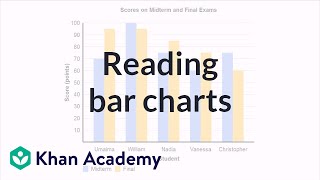 Reading bar charts: comparing two sets of data ✓ Check-ins1:30
 Reading bar charts: putting it together with central tendency ✓ Check-ins4:41
 Reading pie graphs (circle graphs) ✓ Check-ins3:09
Two-way tables

Distributions in two-way tables
Unit 2: Displaying and comparing quantitative data
Displaying quantitative data with graphs


Describing and comparing distributions
More on data displays
Unit 3: Summarizing quantitative data
Measuring center in quantitative data

More on mean and median
 Comparing means of distributions ✓ Check-ins ✎ Fixed a slip7:49
 Means and medians of different distributions ✓ Check-ins6:29
 Impact on median & mean: removing an outlier ✓ Check-ins5:37
 Impact on median & mean: increasing an outlier ✓ Check-ins4:16
 Missing value given the mean ✓ Check-ins5:03
 Median & range puzzlers ✓ Check-ins6:55
Interquartile range (IQR)
Variance and standard deviation of a population
Variance and standard deviation of a sample
More on standard deviation
Box and whisker plots
 Worked example: Creating a box plot (odd number of data points) ✓ Check-ins3:18
 Worked example: Creating a box plot (even number of data points) ✓ Check-ins3:15
 Constructing a box plot ✓ Check-ins8:18
 Reading box plots ✓ Check-ins3:18
 Interpreting box plots ✓ Check-ins7:44
 Judging outliers in a dataset ✓ Check-ins8:21
Unit 4: Modeling data distributions
Percentiles
Z-scores
Effects of linear transformations
Density curves
Normal distributions and the empirical rule
Normal distribution calculations
Unit 5: Exploring bivariate numerical data
Introduction to scatterplots

Correlation coefficients
Introduction to trend lines
Least-squares regression equations
 Introduction to residuals and least squares regression ✓ Check-ins ✎ Fixed a slip7:40
 Calculating residual example ✓ Check-ins4:52
 Calculating the equation of a regression line ✓ Check-ins8:11
 Interpreting slope of regression line ✓ Check-ins2:58
 Interpreting y-intercept in regression model ✓ Check-ins2:36
 Interpreting a trend line ✓ Check-ins3:28
Assessing the fit in least-squares regression
More on regression
 Squared error of regression line ✓ Check-ins6:47
 Proof (part 1) minimizing squared error to regression line ✓ Check-ins10:35
 Proof (part 2) minimizing squared error to regression line ✓ Check-ins9:54
 Proof (part 3) minimizing squared error to regression line ✓ Check-ins10:54
 Proof (part 4) minimizing squared error to regression line ✓ Check-ins4:18
 Regression line example ✓ Check-ins9:27
 Second regression example ✓ Check-ins ✎ Fixed a slip9:15
 Calculating R-squared ✓ Check-ins9:45
 Covariance and the regression line ✓ Check-ins ✎ Fixed a slip15:08
Unit 6: Study design
Statistical questions
Sampling and observational studies
Sampling methods
Types of studies (experimental vs. observational)
Unit 7: Probability
Basic theoretical probability
Probability using sample spaces
Basic set operations

Experimental probability
Randomness, probability, and simulation
Addition rule
Multiplication rule for independent events
 Sample spaces for compound events ✓ Check-ins9:10
 Compound probability of independent events ✓ Check-ins6:00
 Probability of a compound event ✓ Check-ins5:03
 "At least one" probability with coin flipping ✓ Check-ins9:20
 Free-throw probability ✓ Check-ins7:05
 Three-pointer vs free-throw probability ✓ Check-ins5:47
 Probability without equally likely events ✓ Check-ins ✎ Fixed a slip8:58
 Independent events example: test taking ✓ Check-ins4:44
 Die rolling probability with independent events ✓ Check-ins2:28
Multiplication rule for dependent events
Conditional probability and independence

Unit 8: Counting, permutations, and combinations
Counting principle and factorial
Permutations


Combinations
Combinatorics and probability
 Probability using combinations ✓ Check-ins9:10
 Probability & combinations (2 of 2) ✓ Check-ins ✎ Fixed a slip10:36
 Example: Different ways to pick officers ✓ Check-ins2:23
 Example: Combinatorics and probability ✓ Check-ins ✎ Fixed a slip10:51
 Getting exactly two heads (combinatorics) ✓ Check-ins10:00
 Exactly three heads in five flips ✓ Check-ins6:51
 Generalizing with binomial coefficients (bit advanced) ✓ Check-ins ✎ Fixed a slip11:40
 Example: Lottery probability ✓ Check-ins5:10
 Conditional probability and combinations ✓ Check-ins16:52
 Mega millions jackpot probability ✓ Check-ins5:30
 Birthday probability problem ✓ Check-ins ✎ Fixed a slip13:16
Unit 9: Random variables
Discrete random variables
 Random variables ✓ Check-ins ✎ Fixed a slip5:32
 Discrete and continuous random variables ✓ Check-ins11:57
 Constructing a probability distribution for random variable ✓ Check-ins6:48
 Probability models example: frozen yogurt ✓ Check-ins7:25
 Valid discrete probability distribution examples ✓ Check-ins4:00
 Probability with discrete random variable example ✓ Check-ins3:50
 Mean (expected value) of a discrete random variable ✓ Check-ins4:32
 Variance and standard deviation of a discrete random variable ✓ Check-ins6:26
Continuous random variables
Transforming random variables
Combining random variables
 Mean of sum and difference of random variables ✓ Check-ins3:22
 Variance of sum and difference of random variables ✓ Check-ins8:07
 Intuition for why independence matters for variance of sum ✓ Check-ins4:23
 Deriving the variance of the difference of random variables ✓ Check-ins10:47
 Example: Analyzing distribution of sum of two normally distributed random variables ✓ Check-ins5:51
 Example: Analyzing the difference in distributions ✓ Check-ins9:45
Binomial random variables
 Binomial variables ✓ Check-ins7:31
 Recognizing binomial variables ✓ Check-ins6:42
 10% Rule of assuming "independence" between trials ✓ Check-ins6:43
 Binomial distribution ✓ Check-ins ✎ Fixed a slip11:52
 Visualizing a binomial distribution ✓ Check-ins9:27
 Binomial probability example ✓ Check-ins ✎ Fixed a slip10:24
 Generalizing k scores in n attempts ✓ Check-ins ✎ Fixed a slip4:13
 Free throw binomial probability distribution ✓ Check-ins8:39
 Graphing basketball binomial distribution ✓ Check-ins4:22
 Binompdf and binomcdf functions ✓ Check-ins5:27
Binomial mean and standard deviation formulas
 Mean and variance of Bernoulli distribution example ✓ Check-ins ✎ Fixed a slip8:20
 Bernoulli distribution mean and variance formulas ✓ Check-ins ✎ Fixed a slip6:59
 Expected value of a binomial variable ✓ Check-ins ✎ Fixed a slip6:33
 Variance of a binomial variable ✓ Check-ins ✎ Fixed a slip6:51
 Finding the mean and standard deviation of a binomial random variable ✓ Check-ins5:02
Geometric random variables
 Geometric random variables introduction ✓ Check-ins6:15
 Probability for a geometric random variable ✓ Check-ins2:51
 Cumulative geometric probability (greater than a value) ✓ Check-ins ✎ Fixed a slip5:03
 Cumulative geometric probability (less than a value) ✓ Check-ins4:07
 TI-84 geometpdf and geometcdf functions ✓ Check-ins5:48
 Proof of expected value of geometric random variable ✓ Check-ins7:19
More on expected value
 Term life insurance and death probability ✓ Check-ins4:22
 Getting data from expected value ✓ Check-ins ✎ Fixed a slip9:52
 Expected profit from lottery ticket ✓ Check-ins9:18
 Expected value while fishing ✓ Check-ins8:24
 Comparing insurance with expected value ✓ Check-ins9:16
 Law of large numbers ✓ Check-ins8:59
Unit 10: Sampling distributions
What is a sampling distribution?
Sampling distribution of a sample proportion
Sampling distribution of a sample mean
 Inferring population mean from sample mean ✓ Check-ins10:03
 Central limit theorem ✓ Check-ins9:49
 Sampling distribution of the sample mean ✓ Check-ins10:52
 Sampling distribution of the sample mean (part 2) ✓ Check-ins ✎ Fixed a slip13:20
 Standard error of the mean ✓ Check-ins ✎ Fixed a slip15:15
 Example: Probability of sample mean exceeding a value ✓ Check-ins ✎ Fixed a slip14:28
Unit 11: Confidence intervals
Introduction to confidence intervals
Estimating a population proportion
 Confidence interval example ✓ Check-ins ✎ Fixed a slip18:36
 Margin of error 1 ✓ Check-ins ✎ Fixed a slip15:02
 Margin of error 2 ✓ Check-ins ✎ Fixed a slip10:05
 Conditions for valid confidence intervals for a proportion ✓ Check-ins6:44
 Conditions for confidence interval for a proportion worked examples ✓ Check-ins ✎ Fixed a slip4:54
 Critical value (z*) for a given confidence level ✓ Check-ins6:22
 Example constructing and interpreting a confidence interval for p ✓ Check-ins6:35
 Determining sample size based on confidence and margin of error ✓ Check-ins8:01
Estimating a population mean
 Introduction to t statistics ✓ Check-ins ✎ Fixed a slip4:26
 Simulation showing value of t statistic ✓ Check-ins3:14
 Conditions for valid t intervals ✓ Check-ins4:54
 Example finding critical t value ✓ Check-ins ✎ Fixed a slip3:59
 Example constructing a t interval for a mean ✓ Check-ins5:58
 Confidence interval for a mean with paired data ✓ Check-ins9:46
 Sample size for a given margin of error for a mean ✓ Check-ins7:42
More confidence interval videos
Unit 12: Significance tests (hypothesis testing)
The idea of significance tests
 Simple hypothesis testing ✓ Check-ins6:25
 Idea behind hypothesis testing ✓ Check-ins7:49
 Examples of null and alternative hypotheses ✓ Check-ins ✎ Fixed a slip5:42
 P-values and significance tests ✓ Check-ins7:58
 Comparing P-values to different significance levels ✓ Check-ins4:41
 Estimating a P-value from a simulation ✓ Check-ins4:45
Error probabilities and power
Tests about a population proportion
 Constructing hypotheses for a significance test about a proportion ✓ Check-ins4:16
 Conditions for a z test about a proportion ✓ Check-ins5:33
 Calculating a z statistic in a test about a proportion ✓ Check-ins ✎ Fixed a slip4:51
 Calculating a P-value given a z statistic ✓ Check-ins5:27
 Making conclusions in a test about a proportion ✓ Check-ins5:14
Tests about a population mean
 Writing hypotheses for a significance test about a mean ✓ Check-ins2:34
 Conditions for a t test about a mean ✓ Check-ins5:48
 When to use z or t statistics in significance tests ✓ Check-ins4:51
 Example calculating t statistic for a test about a mean ✓ Check-ins5:02
 Using TI calculator for P-value from t statistic ✓ Check-ins3:19
 Using a table to estimate P-value from t statistic ✓ Check-ins4:53
 Comparing P-value from t statistic to significance level ✓ Check-ins3:39
 Free response example: Significance test for a mean ✓ Check-ins11:53
More significance testing videos
Unit 13: Two-sample inference for the difference between groups
Comparing two proportions
Comparing two means
 Statistical significance of experiment ✓ Check-ins8:04
 Statistical significance on bus speeds ✓ Check-ins11:36
 Difference of sample means distribution ✓ Check-ins12:18
 Confidence interval of difference of means ✓ Check-ins ✎ Fixed a slip15:49
 Clarification of confidence interval of difference of means ✓ Check-ins2:41
 Hypothesis test for difference of means ✓ Check-ins ✎ Fixed a slip10:06
Unit 14: Inference for categorical data (chi-square tests)
Chi-square goodness-of-fit tests
Chi-square tests for relationships
Unit 15: Advanced regression (inference and transforming)
Inference about slope
 Introduction to inference about slope in linear regression ✓ Check-ins7:12
 Conditions for inference on slope ✓ Check-ins4:51
 Confidence interval for the slope of a regression line ✓ Check-ins6:55
 Calculating t statistic for slope of regression line ✓ Check-ins7:16
 Using a P-value to make conclusions in a test about slope ✓ Check-ins6:25
 Using a confidence interval to test slope ✓ Check-ins3:54
Unit 16: Analysis of variance (ANOVA)

Learn this with a class
With a class on Puzzicle this course runs as a timetable of live study parties: your batch watches together and answers the check-ins, sometimes with a teacher leading.
Course content © Khan Academy, used under CC BY-NC-SA. See this course on Khan Academy.