World history
From the earliest civilizations to the modern world, geography, religion, trade, and politics have bound peoples and nations together—and torn them apart. Take a journey through time and space and discover the fascinating history behind the complex world we inhabit today
15 units376 videos60 hours
Learn it live with a class on Puzzicle · Teachers: use it with your class
Unit 1: Origins of History
History Stories | 1.1


History of Many Shapes and Sizes | 1.2
History Frames | 1.3


History and Memory | 1.4


Unit 2: Early Humans (250,000 BP to 3000 BCE)
The Earliest Humans | 2.1
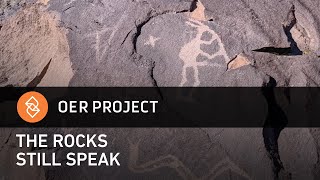
Migration and Art | 2.2
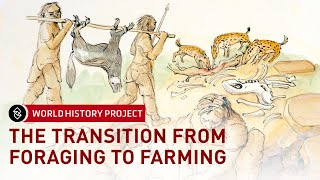
Foraging Societies | 2.3
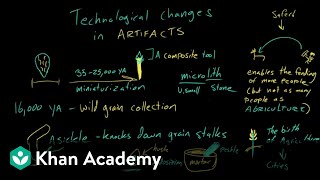
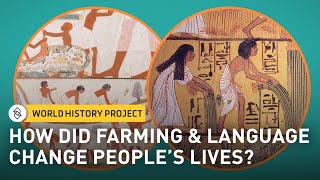
The Agricultural Revolution | 2.4
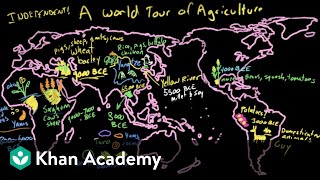



The Biggest Mistake Humans Ever Made? | 2.5
Unit 3: Early Agrarian Societies (6000 BCE to 100 CE)
Cities, Societies, and Empires | 3.1
Ancient Trade Networks | 3.4
Ancient Mesopotamia | 3.6
Shang Dynasty China | 3.7
Nubia and Ancient Egypt | 3.8
Ancient Americas | 3.10


Indus River Valley | 3.11
Unit 4: Empires and Belief Systems (600 BCE to 700 CE)
Empires and Belief Systems | 4.1
Confucianism, Legalism, and Daoism | 4.3
Hinduism and Buddhism | 4.4

Judaism and Christianity | 4.5


Ancient Empires: Persians and Greeks | 4.9
Ancient Empires: Mauryan and Gupta | 4.10
Ancient Empires: Zhou and Qin | 4.11
Ancient Empires: Rome and Han China | 4.13
The Rise and Fall of Empires | 4.14
Women in the Ancient World | 4.15
Unit 5: Regional Webs (200 to 1500 CE)
Collapse and Restructuring | 5.1
Why Do Empires Collapse? | 5.2
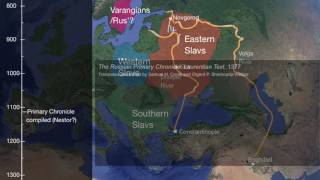
Systems Restructure in Europe | 5.4
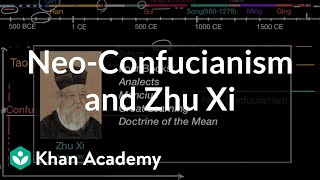
Systems Restructure in China | 5.5
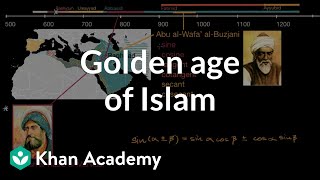
The Islamic World | 5.6

The Silk Roads | 5.7
Expanding the Silk Roads | 5.8
 Silk and the Song Dynasty ✓ Check-ins12:28
 Guilds, Wool, and Trade: Medieval England in a Global Economy ✓ Check-ins9:30
 Mansa Musa and Islam in Africa ✓ Check-ins10:31
 Prosperity in Song China (960-1279) ✓ Check-ins4:36
 Classical Japan during the Heian Period ✓ Check-ins3:43
 Shoguns, samurai and the Japanese Middle Ages ✓ Check-ins6:27
Unit 6: The First Global Age (1200 to 1750 CE)
The First Global Age | 6.1
The Mongol Empire | 6.2
Cultural Exchange in Afro-Eurasia | 6.4
Communities in the Americas | 6.5
Trade Routes in the Americas | 6.6
Empires Expand | 6.7
Age of Exploration | 6.8
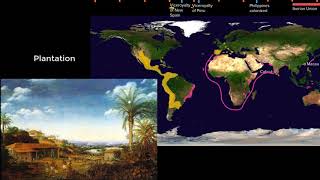
The Columbian Exchange | 6.9
The Transatlantic Slave Trade | 6.10
Unit 7: The Long Nineteenth Century (1750 to 1914 CE)
The Long Nineteenth Century | 7.1
Enlightenment and Revolution | 7.2
Atlantic Revolutions | 7.3
 The Haitian Revolution ✓ Check-ins12:17
 Background and introduction to the United States Declaration of Independence ✓ Check-ins8:38
 Birth of the US Constitution ✓ Check-ins12:43
 French Revolution (part 1) ✓ Check-ins17:05
 French Revolution (part 2) ✓ Check-ins14:51
 French Revolution (part 3) - Reign of Terror ✓ Check-ins23:29
 French Revolution (part 4) - The Rise of Napoleon Bonaparte ✓ Check-ins16:48
 Latin American independence movements ✓ Check-ins5:49
 Haitian Revolution (Part 1) ✓ Check-ins27:15
 Haitian Revolution (Part 2) ✓ Check-ins16:54
Nationalism | 7.4
The Industrial Revolution | 7.5
Comparing Industrialization in Egypt and Japan | 7.6
The Working Class | 7.7
Industrial Imperialism | 7.9
Resisting Colonialism | 7.10
Unit 8: Global Conflict (1914 to 1991 CE)
Century of Conflict | 8.1


Causes of the First World War | 8.2

The First Total War | 8.3
 Britain and World War I ✓ Check-ins12:42
 Italian front in World War I ✓ Check-ins9:09
 Japan in World War I ✓ Check-ins3:54
 United States enters World War I ✓ Check-ins7:05
 Comparing the Eastern and Western fronts in WWI ✓ Check-ins4:22
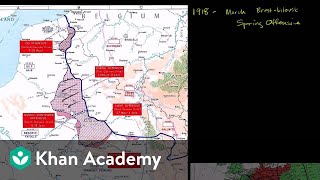 Closing stages of World War I ✓ Check-ins10:26
 Technology in World War I ✓ Check-ins8:05
A World Remade | 8.4

Interwar Ideologies | 8.5
 What is Fascism?13:16
 Internationalism Between the Wars10:24
 Initial rise of Hitler and the Nazis ✓ Check-ins11:07
 Hitler and the Nazis come to power ✓ Check-ins11:56
 Nazi aggression and appeasement ✓ Check-ins7:00
 Fascism and Mussolini ✓ Check-ins8:35
 Mussolini becomes absolute dictator (Il Duce) ✓ Check-ins8:26
 Mussolini aligns with Hitler ✓ Check-ins7:43
 Overview of Chinese history 1911 - 1949 ✓ Check-ins11:07
The Second World War | 8.6
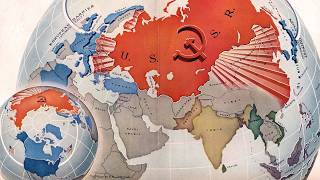
The Cold War | 8.8




Unit 9: Globalization (1900 CE to the Present)
Our Interconnected World | 9.1

Is Globalization Good or Bad? | 9.2
The Great Acceleration | 9.4

Global Communities | 9.5
Experiencing Globalization | 9.7
The Anthropocene? | 9.8
Unit 10: Beginnings - 600 BCE
The origin of humans and early human societies
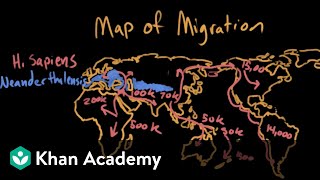
The Neolithic Revolution and the birth of agriculture
Ancient Mesopotamia
Ancient Egypt
Ancient art and artifacts
Ancient India
Ancient Americas
Unit 11: 600 BCE - 600 CE Second-Wave Civilizations
Ancient Persia
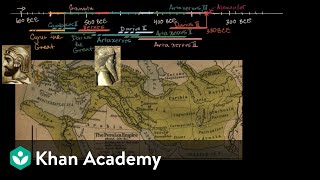
Classical Greece
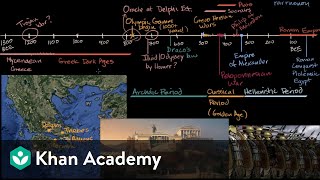 Classical Greece ✓ Check-ins11:49
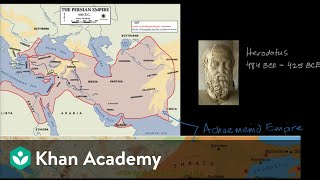 Greco Persian Wars ✓ Check-ins9:34
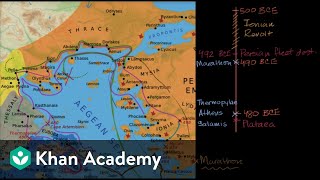 Second Persian Invasion ✓ Check-ins8:57
 Classical Greek Society and Culture ✓ Check-ins10:10
 Philosophy: Socrates, Plato and Aristotle ✓ Check-ins10:57
 Prelude to the Peloponnesian War ✓ Check-ins9:41
 The Peloponnesian War ✓ Check-ins8:19
The rise and fall of empires
Empire of Alexander the Great
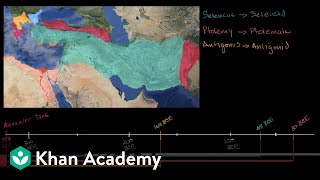
Rise of Rome
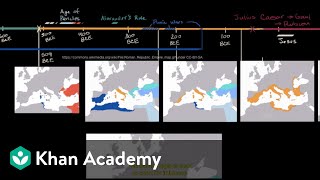
From Roman Republic to Roman Empire
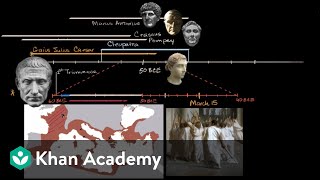
The Roman Empire

Ancient and Imperial China
Early Christianity
Early Americas
Early Hinduism
 The Vedic Period ✓ Check-ins8:12
 Sanskrit connections to English ✓ Check-ins9:31
 Hinduism: core ideas of Brahman, Atman, Samsara and Moksha. ✓ Check-ins10:10
 Hindu gods overview ✓ Check-ins8:09
 Hindu scripture overview ✓ Check-ins8:18
 Varnas and the Caste System ✓ Check-ins8:08
 Bhakti movement ✓ Check-ins7:09
Early Buddhism


Women and families
Transregional Trade: the Silk Road
Survey of second-wave civilizations
Unit 12: 600 - 1450 Regional and interregional interactions
Byzantine Empire
European Middle Ages: feudalism and serfdom

Origins of Islam
Sunni and Shia Islam
Golden Age of Islam
The Great Schism
The Crusades
The Mongols
Song China
Medieval Japan
Maya, Aztec, and Inca
Environment and trade
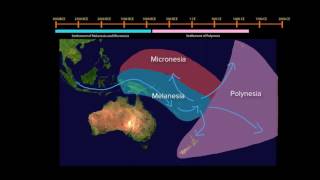
Human migration
Development of financial institutions
Unit 13: 1450 - 1750 Renaissance and Reformation
Spanish and Portuguese Empires
Scientific Revolution and Enlightenment
Mughal rule in India
Sikhism

The Protestant Reformation
 Introduction to the Protestant Reformation: Setting the stage ✓ Check-ins8:18
 Introduction to the Protestant Reformation: Martin Luther ✓ Check-ins11:15
 Introduction to the Protestant Reformation: Varieties of Protestantism ✓ Check-ins8:16
 Introduction to the Protestant Reformation: The Counter-Reformation ✓ Check-ins9:41
The Russian Empire
Unit 14: 1750 -1900 Enlightenment and Revolution
American Revolution
French Revolution
Napoleon Bonaparte
 Napoleon and the Wars of the First and Second Coalitions ✓ Check-ins13:18
 Napoleon and the War of the Third Coalition ✓ Check-ins21:52
 Napoleon and the War of the Fourth Coalition ✓ Check-ins16:18
 Napoleon's Peninsular Campaigns ✓ Check-ins20:22
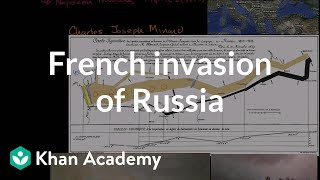 French invasion of Russia ✓ Check-ins16:39
 Napoleon forced to abdicate ✓ Check-ins16:22
 Hundred days and Waterloo ✓ Check-ins7:33
France's many revolutions and republics

Haitian Revolution
Latin American independence
Unit 15: The 20th century
Beginning of World War I
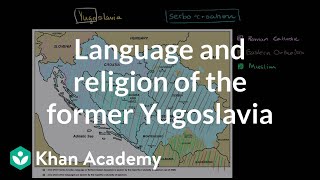

Other fronts of World War I
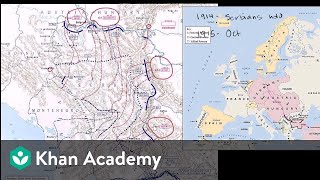
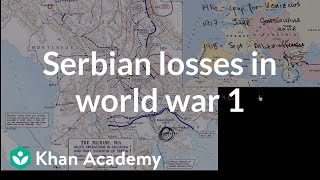
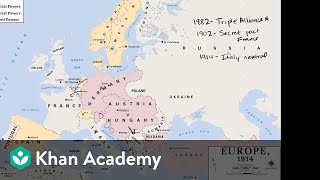
Western and Eastern fronts of World War I
 Schlieffen Plan and the First Battle of the Marne ✓ Check-ins7:18
- Comparing the Eastern and Western fronts in WWI ✓ Check-ins4:22
 World War I Eastern front ✓ Check-ins11:47
 Battles of Verdun, Somme and the Hindenburg Line ✓ Check-ins6:32
- Closing stages of World War I ✓ Check-ins10:26
- Technology in World War I ✓ Check-ins8:05
Blockades and American entry
World War I shapes the Middle East

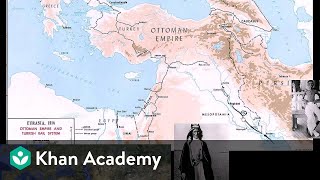
Aftermath of World War I

Rise of Hitler and the Nazis
Rise of Mussolini and Fascism
Overview of Chinese history 1911-1949
Overview of World War II
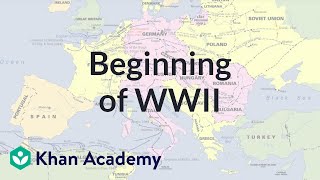 Beginning of World War II ✓ Check-ins7:55
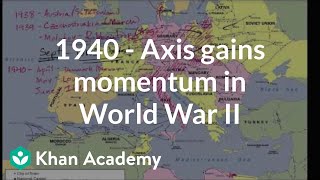 1940 - Axis gains momentum in World War II ✓ Check-ins6:14
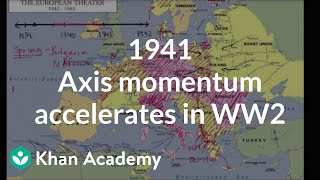 1941 Axis momentum accelerates in WW2 ✓ Check-ins12:12
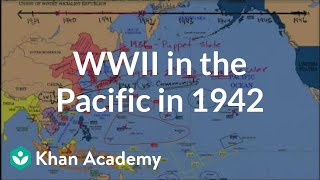 World War II in the Pacific ✓ Check-ins5:51
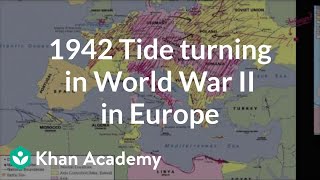 1942 - Tide turning in World War II in Europe ✓ Check-ins5:12
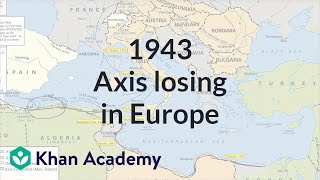 1943 - Axis powers losing in Europe ✓ Check-ins4:56
 American progress in the Pacific in 1944 ✓ Check-ins7:35
 1944 - Allies advance further in Europe ✓ Check-ins6:25
 End of World War II ✓ Check-ins8:04
The Cold War

Learn this with a class
With a class on Puzzicle this course runs as a timetable of live study parties: your batch watches together and answers the check-ins, sometimes with a teacher leading.
Course content © Khan Academy, used under CC BY-NC-SA. See this course on Khan Academy.