4th grade (Eureka Math Squared-aligned)
This course contains Khan Academy practice problems crafted to support the Eureka Math Squared (EM2) curriculum. Designed to make it easier for districts, teachers, and students to find and use practice problems that complement EM2 lessons, this course was not produced in official partnership with Eureka Math Squared.
6 units232 videos15 hours
Learn it live with a class on Puzzicle · Teachers: use it with your class
Unit 1: Place Value Concepts for Addition and Subtraction
Interpret multiplication as multiplicative comparison
Solve multiplicative comparison problems with unknowns in various positions
Organize, count, and represent a collection of objects
Demonstrate that a digit represents 10 times the value of what it represents in the place to its right
Write numbers to 1,000,000 in unit form and expanded form by using place value structure
Write numbers to 1,000,000 in standard form and word form
Compare numbers within 1,000,000 by using >, =, and <
Name numbers by using place value understanding
Round to the nearest thousand
Round to the nearest ten thousand and hundred thousand
Round multi-digit numbers to any place
Apply estimation to real-world situations by using rounding

Add by using the standard algorithm
 Relate place value to standard algorithm for multi-digit addition ✓ Check-ins6:22
 Using place value to add 3-digit numbers: part 1 ✓ Check-ins2:26
 Using place value to add 3-digit numbers: part 2 ✓ Check-ins2:30
 Adding 3-digit numbers ✓ Check-ins3:04
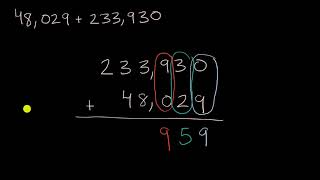 Adding multi-digit numbers: 48,029+233,930 ✓ Check-ins2:18
Solve multi-step addition word problems by using the standard algorithm
Subtract by using the standard algorithm, decomposing larger units once
Subtract by using the standard algorithm, decomposing larger units up to 3 times
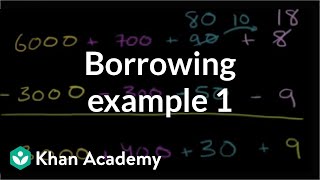
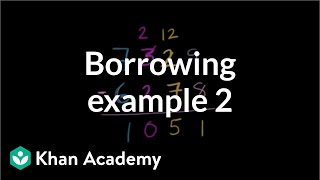
Subtract by using the standard algorithm, decomposing larger units multiple times
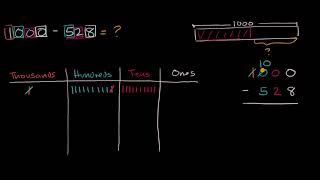
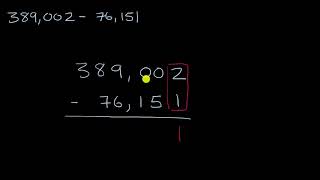
Solve multi-step word problems by using addition and subtraction
Express metric measurements of length in terms of smaller units
Express metric measurements of mass and liquid volume in terms of smaller units
Additional content
 Locating large numbers on a number line ✓ Check-ins3:18
 Number sense and place value reasoning ✓ Check-ins1:24
 Comparing place values ✓ Check-ins2:30
 Ordering multi digit numbers ✓ Check-ins1:31
 Ordering large numbers: least to greatest ✓ Check-ins4:23
 Ordering large numbers: greatest to least ✓ Check-ins3:11
 Estimating large sums ✓ Check-ins3:06
 Estimating large differences ✓ Check-ins2:19
 How to convert kg to mg and T to oz ✓ Check-ins4:24
Unit 2: Place Value Concepts for Multiplication and Division
Investigate and use a formula for the area of a rectangle
Multiply with regrouping by using place value strategies and the distributive property
Multiply by applying the distributive property and write equations
Solve multiplication word problems
Divide three-digit numbers by one-digit numbers by using an area model
Express measurements of length in terms of smaller units
Apply area and perimeter formulas to solve problems
 Area & perimeter word problem: dog pen ✓ Check-ins3:14
 Area & perimeter word problem: table ✓ Check-ins4:46
 Comparing areas word problem ✓ Check-ins2:21
 Finding missing side length when given perimeter ✓ Check-ins4:55
 Finding side lengths of rectangles given the perimeter ✓ Check-ins2:14
 Using multiplication to compare perimeters of rectangles ✓ Check-ins2:21
Solve word problems involving additive and multiplicative comparisons

Find factor pairs for numbers up to 100 and use factors to identify numbers as prime or composite
Determine whether a whole number is a multiple of another number
Recognize that a number is a multiple of each of its factors
Explore properties of prime and composite numbers up to 100 by using multiples
Use relationships within a pattern to find an unknown term in the sequence
Unit 3: Multiplication and Division of Multi-Digit Numbers
Divide multiples of 100 and 1000
Multiply by multiples of 100 and 1000
Apply place value strategies to divide hundreds, tens, and ones
Apply place value strategies to divide thousands, hundreds, tens, and ones

Connect pictorial representations of division to long division
Represent division by using partial quotients
Apply place value strategies to multiply four-digit numbers by one-digit numbers
Represent multiplication by using partial products
Multiply by using various recording methods in vertical form
Multiply two-digit numbers by two-digit multiples of 10
Apply place value strategies to multiply two-digit numbers by two-digit numbers
Multiply with two partial products
Apply the distributive property to multiply
Express units of time in terms of smaller units
Express customary measurements of weight in terms of smaller units
Express customary measurements of liquid volume in terms of smaller units
Represent, estimate, and solve division word problems
Solve multi-step word problems and assess the reasonableness of solutions
 Estimating with multiplication ✓ Check-ins3:09
 Estimating 2-digit multiplication ✓ Check-ins2:44
 2-step estimation word problem ✓ Check-ins3:05
 Solving multi-step problems (multiplication): camping items ✓ Check-ins2:35
 Solving multi-step problems (multiplication): firewood ✓ Check-ins2:20
 Division word problem: field goals ✓ Check-ins2:59
 2-step word problem: truffles ✓ Check-ins5:00
 2-step word problem: running ✓ Check-ins3:32
 2-step word problem: theater ✓ Check-ins3:01
 Solving multi-step problems (division): books ✓ Check-ins2:22
 Solving multi-step problems (division): cookies ✓ Check-ins2:09
 Word problem: making change ✓ Check-ins3:14
 Currency conversion word problem ✓ Check-ins0:54
 Multi-step unit conversion examples (U.S. Customary) ✓ Check-ins5:37
Unit 4: Foundations for Fraction Operations
Decompose whole numbers into a sum of unit fractions
Decompose fractions into a sum of unit fractions
Represent fractions by using various fraction models
Rename fractions greater than 1 as mixed numbers
Generate equivalent fractions with larger units
Represent equivalent fractions by using tape diagrams, number lines, and multiplication or division
Generate a common numerator or denominator to compare fractions
 Finding common denominators ✓ Check-ins4:42
 Common denominators: 1/4 and 5/6 ✓ Check-ins8:19
 Common denominators: 3/5 and 7/2 ✓ Check-ins4:15
 Comparing fractions: tape diagram ✓ Check-ins2:35
 Comparing fractions: number line ✓ Check-ins2:55
 Comparing fractions: fraction models ✓ Check-ins2:32
 Comparing fractions 1 (unlike denominators) ✓ Check-ins4:16
 Comparing fractions word problems ✓ Check-ins5:07
Estimate sums and differences of fractions by using benchmarks
Add and subtract fractions with like units
Subtract a fraction from a whole number
Solve addition and subtraction word problems and estimate the reasonableness of the answers
Add a mixed number to a mixed number
Subtract a mixed number from a mixed number
Represent and solve word problems with mixed numbers by using drawings and equations
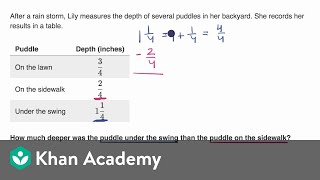
Solve problems by using data from a line plot
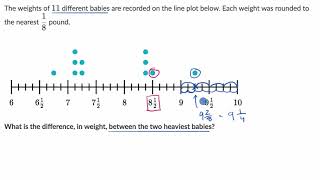
Represent data on a line plot
Decompose non-unit fractions into a product of a whole number and a unit fraction
Multiply a fraction by a whole number by using the associative property
Solve word problems involving multiplication of a fraction by a whole number
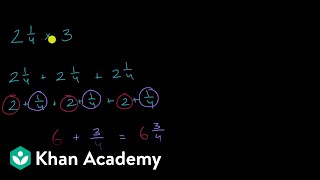
Multiply a mixed number by a whole number by using the distributive property
Unit 5: Place Value Concepts for Decimal Fractions
Organize, count, and represent a collection of money
Decompose 1 one and express tenths in fraction form and decimal form
Represent tenths as a place value unit
Decompose 1 one and express hundredths in fraction form and decimal form
Represent hundredths as a place value unit
Write mixed numbers in decimal form with hundredths
Use pictorial representations to compare decimal numbers
Compare and order decimal numbers
Apply fraction equivalence to add tenths and hundredths
Solve word problems with tenths and hundredths
Unit 6: Angle Measurements and Plane Figures
Identify and draw points, lines, line segments, rays, and angles
Identify right, acute, obtuse, and straight angles
Draw right, acute, obtuse, and straight angles

Identify, define, and draw parallel lines
Explore angles as fractional turns through a circle
Use a circular protractor to recognize a 1° angle as a turn through 1/360 of a circle
Use a protractor to draw angles up to 180°
Decompose angles by using pattern blocks
Find unknown angle measures within a decomposed angle of up to 180°
Recognize, identify, and draw lines of symmetry
Construct and classify triangles based on given attributes

Sort polygons based on a given rule
Additional content
Learn this with a class
With a class on Puzzicle this course runs as a timetable of live study parties: your batch watches together and answers the check-ins, sometimes with a teacher leading.
Course content © Khan Academy, used under CC BY-NC-SA. See this course on Khan Academy.