6th grade (Eureka Math Squared-aligned)
This course contains Khan Academy practice problems crafted to support the Eureka Math Squared (EM2) curriculum. Designed to make it easier for districts, teachers, and students to find and use practice problems that complement EM2 lessons, this course was not produced in official partnership with Eureka Math Squared.
6 units193 videos12 hours
Learn it live with a class on Puzzicle · Teachers: use it with your class
Unit 1: Ratios, rates, and percents
Jars of jelly beans
Ratios and tape diagrams
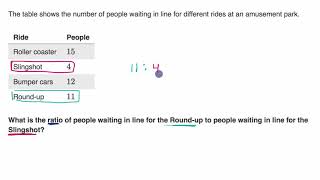
Exploring ratios by making batches
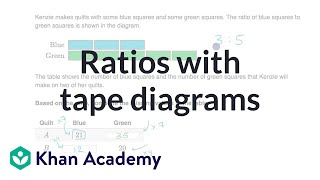
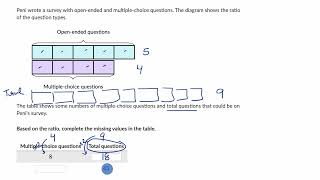
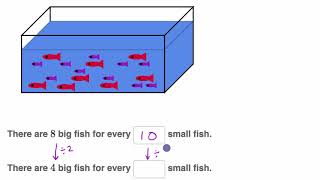
Equivalent ratios
Ratio tables and double number lines
Graphs of ratio relationships
Multiplication patterns in ratio relationships
Applications of ratio reasoning
Rates
Comparing rates
Using rates to convert units
Solving rate problems
Introduction to percents
Finding a part
Finding the whole
Solving percent problems
Unit 2: Operations with fractions and multi-digit numbers
Factors and multiples
Divisibility
The greatest common factor
The least common multiple
The Euclidean algorithm (optional)
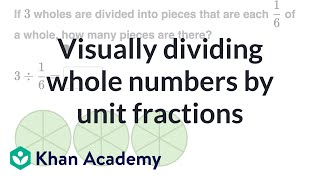
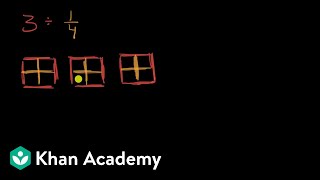
Dividing a whole number by a fraction
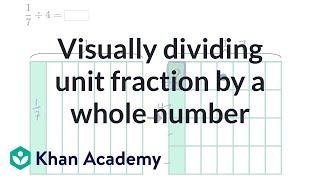
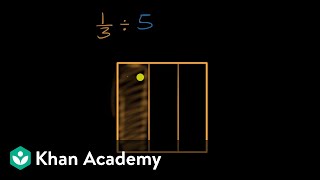
Dividing a fraction by a whole number
Dividing fractions by using the invert and multiply strategy
 Understanding division of fractions ✓ Check-ins5:42
 Dividing fractions: 2/5 ÷ 7/3 ✓ Check-ins1:17
 Dividing fractions: 3/5 ÷ 1/2 ✓ Check-ins3:36
 Meaning of the reciprocal ✓ Check-ins4:13
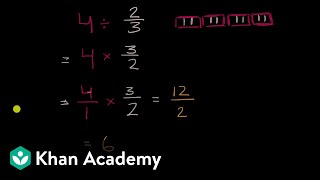 Dividing a whole number by a fraction ✓ Check-ins3:05
 Dividing a whole number by a fraction with reciprocal ✓ Check-ins3:36
 Dividing mixed numbers ✓ Check-ins2:41
Applications of fraction division
Fraction operations in a real-world situation
Decimal addition and subtraction
Patterns in multiplying decimals
Decimal multiplication

Applications of decimal operations
The standard division algorithm
Expressing quotients as decimals
Unit 3: Rational numbers
Positive and negative numbers
Integers
Rational numbers
Comparing rational numbers
Ordering rational numbers
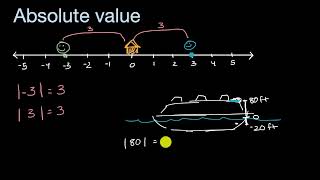
Absolute value and order
Interpreting order and distance in real-world situations
The four quadrants of the coordinate plane
Plotting points in the coordinate plane
Constructing the coordinate plane
Distance in the coordinate plane
Figures in the coordinate plane
Unit 4: Expressions and one-step equations
Expressions with multiplication and division
Exploring exponents

Evaluating expressions with exponents
Exploring order of operations
Order of operations
Algebraic expressions with addition, subtraction, multiplication, and division


Applying properties to multiplication and division expressions

The distributive property
Using the distributive property to factor expressions
Combining like terms by using the distributive property
Equivalent algebraic expressions
Equations and solutions
Inequalities and solutions
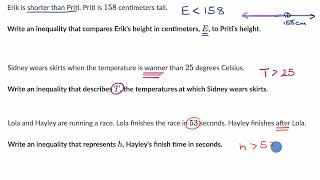
Solving equations with addition and subtraction
 Same thing to both sides of equations ✓ Check-ins2:32
 Representing a relationship with an equation ✓ Check-ins3:24
 Dividing both sides of an equation ✓ Check-ins3:14
 One-step equations intuition ✓ Check-ins4:39
 One-step addition & subtraction equations ✓ Check-ins2:09
 One-step addition equation ✓ Check-ins1:54
 One-step addition & subtraction equations: fractions & decimals ✓ Check-ins4:32
Solving equations with multiplication and division
 One-step multiplication equations ✓ Check-ins2:23
 One-step division equations ✓ Check-ins11:06
 One-step multiplication & division equations: fractions & decimals ✓ Check-ins7:51
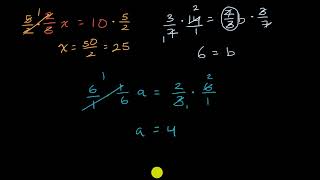 One-step multiplication equations: fractional coefficients ✓ Check-ins3:54
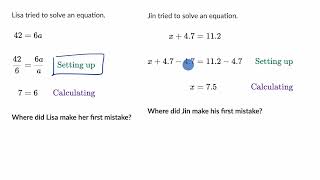 Finding mistakes in one-step equations ✓ Check-ins4:12
Solving problems with equations
Relationship between two variables
Graphs of ratio relationships
Graphs of non–ratio relationships
Unit 5: Area, surface area, and volume
The area of a parallelogram
The area of a right triangle
The area of a triangle
Areas of triangles in real-world situations
Perimeter and area in the coordinate plane
Areas of trapezoids and other polygons
Properties of solids
Discovering nets of solids

Constructing nets of solids
Surface area in real-world situations
Exploring volume
Applying volume formulas
Problem solving with volume
Volumes of composite solids
Unit 6: Statistics
Posing statistical questions
Creating a dot plot
Creating a histogram

Selecting a data display
Using the mean to describe the center
Variability in a data distribution
The mean absolute deviation
Using the interquartile range to describe variability
More practice with box plots
Interpreting box plots
Connecting graphical representations and summary measures
Learn this with a class
With a class on Puzzicle this course runs as a timetable of live study parties: your batch watches together and answers the check-ins, sometimes with a teacher leading.
Course content © Khan Academy, used under CC BY-NC-SA. See this course on Khan Academy.