7th grade math (IM® v.360 aligned)
This course contains Khan Academy practice problems crafted to support the IM® v.360 curriculum by Illustrative Mathematics® (IM), licensed under Creative Commons/Attribution/Non-commercial 4.0. Designed to make it easier for districts, teachers, and students to find and use practice problems that complement IM v.360 lessons, this course was not produced in official partnership with Illustrative Mathematics.
8 units214 videos14 hours
Learn it live with a class on Puzzicle · Teachers: use it with your class
Unit 1: Scale drawings
What are scaled copies?
Corresponding parts and scale factors
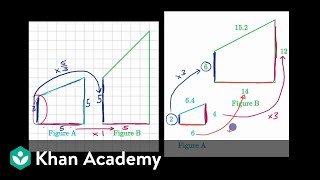
Making scaled copies
Scaled relationships
The size of the scale factor
Scaling and area (optional)
Scale drawings
Creating scale drawings
Changing scales in scale drawings
Scales without units
Unit 2: Introducing proportional relationships
One of these things is not like the other
Introducing proportional relationships with tables
More about constant of proportionality
Proportional relationships and equations
Two equations for each relationship
Write equations to represent relationships
Comparing relationships with tables
Comparing relationship with equations
Introducing graphs of proportional relationships
Interpreting graphs of proportional relationships
Using graphs to compare relationships
Unit 3: Measuring circles
Exploring circles
Exploring circumference
 Radius, diameter, circumference & π ✓ Check-ins11:05
 Explaining the relationship between diameter and circumference: ordered pairs ✓ Check-ins2:22
 Explaining the relationship between diameter and circumference from a graph ✓ Check-ins ✎ Fixed a slip3:53
 Identifying incorrect circle measurements ✓ Check-ins2:01
 Approximating diameter and circumference ✓ Check-ins2:04
Applying circumference
Estimating area
Exploring the area of a circle
Relating area to circumference
Applying area to circles
Unit 4: Proportional relationships and percentages
Ratios and rates with fractions
Revisiting proportional relationships
More than that, less than that
Say it with decimals
Increasing or decreasing
One hundred percent
Percent increase and decrease with equations
Part of a percent
Percentage contexts
Solve multi-step percentage problems
Unit 5: Rational number arithmetic
Interpreting negative numbers
Changing temperatures
Changing elevation
Money and debts
 Rational number word problem: checking account ✓ Check-ins3:15
 Applying signed number addition to money situations: writing equations ✓ Check-ins2:08
 Applying signed number addition to find a final balance ✓ Check-ins0:57
 Applying signed number addition to elevation situations: writing equations ✓ Check-ins1:56
Representing subtraction
Finding differences
Adding and subtracting to solve problems
Multiplying rational numbers (part 1)
Multiplying rational numbers (part 2)
Multiply! (optional)
Dividing rational numbers
Expressions with rational numbers
Solving problems with rational numbers
Solving equations with rational numbers
Unit 6: Expressions, equations, and inequalities
Reasoning about equations and tape diagrams (part 1)
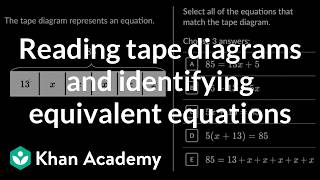
Reasoning about equations and tape diagrams (part 2)
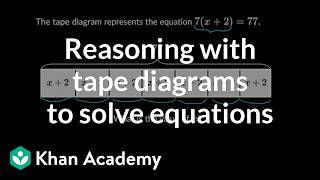
Distinguishing between two types of situations
Reasoning about solving equations (part 1)
Dealing with negative numbers
Different options for solving one equations
Using equations to solve problems
Solving problems about percent increase or decrease
Reintroducing inequalities
Finding solutions to inequalities in context
Efficiently solving inequalities
Modeling with inequalities
Subtraction with equivalent expressions
Expanding and factoring
Combining like terms (part 1)
Unit 7: Angles, triangles, and prisms
Relationships of angles
Adjacent angles
Nonadjacent angles
Solving for unknown angles
Using equations to solve for unknown angles
Building polygons (part 2)
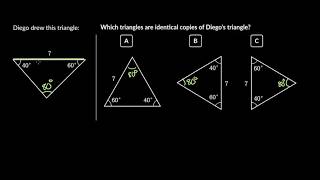
Triangles with 3 common measures
Drawing triangles (part 2)
Slicing solids
Volume of right prisms
 Measuring volume with unit cubes ✓ Check-ins2:13
 Finding the volume of a prism with a polygon base2:16
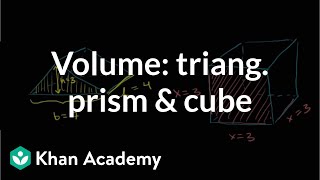 Volume of triangular prism & cube ✓ Check-ins3:56
 Finding a missing dimension of a prism using the volume formula ✓ Check-ins1:29
 Finding the volume of a prism with a polygon base on a grid ✓ Check-ins2:32
Decomposing bases for area
Surface area of right prisms
Distinguishing volume and surface area
Unit 8: Probability and sampling
Mystery bags
Chance experiments
What are probabilities?
Estimating probabilities through repeated experiments
More estimating probabilities
Estimating probabilities using simulation
Simulating multi-step experiments
Keeping track of all possible outcomes
Multi-step experiments
Comparing groups
Sampling in a fair way
What makes a good sample?
Estimating population proportions
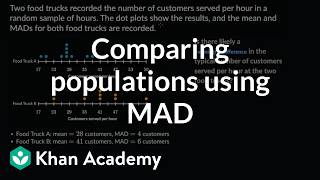
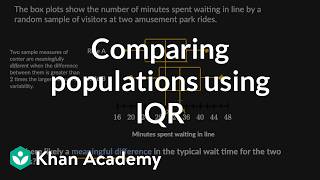
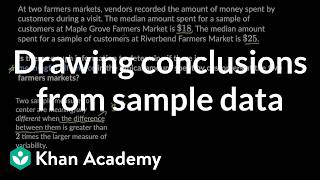
Comparing populations with friends
Learn this with a class
With a class on Puzzicle this course runs as a timetable of live study parties: your batch watches together and answers the check-ins, sometimes with a teacher leading.
Course content © Khan Academy, used under CC BY-NC-SA. See this course on Khan Academy.