Algebra 2
The Algebra 2 course, often taught in the 11th grade, covers Polynomials; Complex Numbers; Rational Exponents; Exponential and Logarithmic Functions; Trigonometric Functions; Transformations of Functions; Rational Functions; and continuing the work with Equations and Modeling from previous grades. Khan Academy's Algebra 2 course is built to deliver a comprehensive, illuminating, engaging, and Common Core aligned experience!
Learn it live with a class on Puzzicle · Teachers: use it with your class
Unit 1: Polynomial arithmetic
Intro to polynomials
Average rate of change of polynomials
Adding and subtracting polynomials
Multiplying monomials by polynomials
Multiplying binomials by polynomials
Unit 2: Complex numbers
The imaginary unit i
Complex numbers introduction
The complex plane
Adding and subtracting complex numbers
Multiplying complex numbers
Quadratic equations with complex solutions
Unit 3: Polynomial factorization
Factoring monomials
 Introduction to factoring higher degree polynomials ✓ Check-ins5:53
 Introduction to factoring higher degree monomials ✓ Check-ins4:43
 Which monomial factorization is correct? ✓ Check-ins2:06
 Worked example: finding the missing monomial factor ✓ Check-ins3:19
 Worked example: finding missing monomial side in area model ✓ Check-ins2:09
Greatest common factor
Taking common factors
Factoring higher degree polynomials
Factoring using structure
Polynomial identities
Unit 4: Polynomial division
Dividing polynomials by x
Dividing quadratics by linear factors
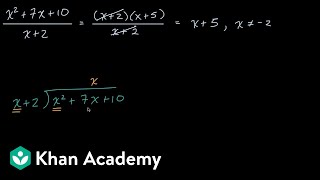
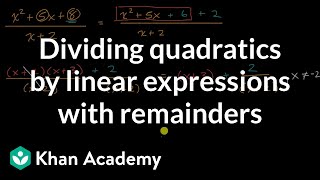
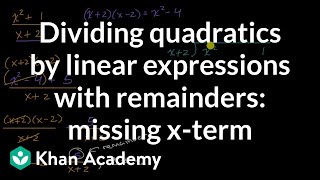
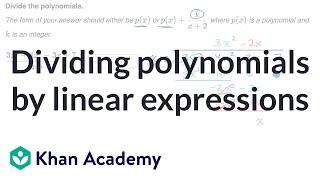
Dividing polynomials by linear factors
Polynomial Remainder Theorem
 Intro to the Polynomial Remainder Theorem ✓ Check-ins6:43
 Remainder theorem: finding remainder from equation ✓ Check-ins3:32
 Remainder theorem examples ✓ Check-ins5:32
 Remainder theorem: checking factors ✓ Check-ins3:26
 Remainder theorem: finding coefficients ✓ Check-ins3:39
 Proof of the Polynomial Remainder Theorem ✓ Check-ins5:42
Unit 5: Polynomial graphs
Zeros of polynomials
 Zeros of polynomials introduction ✓ Check-ins5:09
 Zeros of polynomials: plotting zeros ✓ Check-ins3:19
 Zeros of polynomials: matching equation to zeros ✓ Check-ins3:51
 Zeros of polynomials: matching equation to graph ✓ Check-ins3:01
 Zeros of polynomials (with factoring): grouping ✓ Check-ins4:55
 Zeros of polynomials (with factoring): common factor ✓ Check-ins3:32
Positive and negative intervals of polynomials
End behavior of polynomials
Unit 6: Rational exponents and radicals
Rational exponents
Properties of exponents (rational exponents)
Evaluating exponents & radicals
Equivalent forms of exponential expressions
Solving exponential equations using properties of exponents
Unit 7: Exponential models
Interpreting the rate of change of exponential models
Constructing exponential models according to rate of change
Advanced interpretation of exponential models
Unit 8: Logarithms
Introduction to logarithms
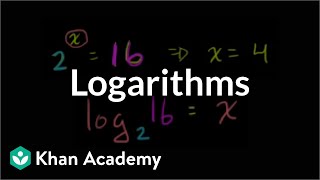
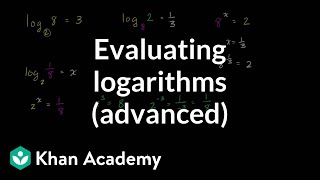
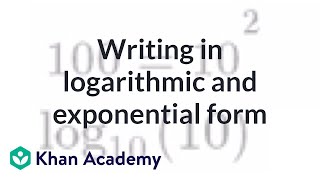
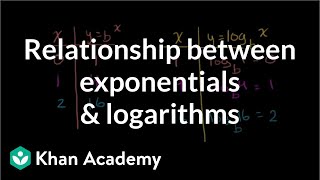
The constant e and the natural logarithm
Properties of logarithms
 Intro to logarithm properties (1 of 2) ✓ Check-ins9:16
 Intro to logarithm properties (2 of 2) ✓ Check-ins10:04
 Using the logarithmic product rule ✓ Check-ins5:04
 Using the logarithmic power rule ✓ Check-ins4:49
 Using the properties of logarithms: multiple steps ✓ Check-ins2:10
 Proof of the logarithm product rule ✓ Check-ins7:08
 Proof of the logarithm quotient and power rules ✓ Check-ins7:59
The change of base formula for logarithms
Solving exponential equations with logarithms
Unit 9: Transformations of functions
Shifting functions
Reflecting functions
Symmetry of functions
Scaling functions
Putting it all together
Graphs of square and cube root functions
Graphs of exponential functions
Unit 10: Equations
Rational equations
Square-root equations
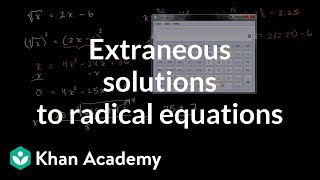
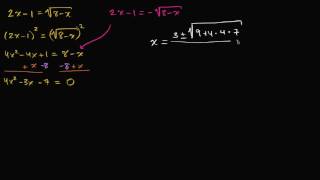
Extraneous solutions
Cube-root equations
Quadratic systems
Unit 11: Trigonometry
Unit circle introduction
Radians
The Pythagorean identity
Trigonometric values of special angles
Graphs of sin(x), cos(x), and tan(x)
Amplitude, midline and period
Transforming sinusoidal graphs
Graphing sinusoidal functions
Unit 12: Modeling
Modeling with function combination
Interpreting features of functions
Manipulating formulas
Modeling with two variables
Modeling with multiple variables
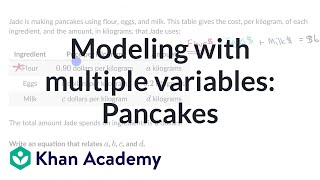 Modeling with multiple variables: Pancakes ✓ Check-ins2:25
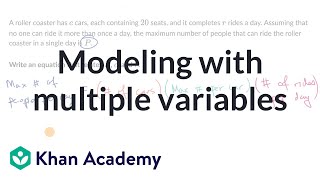 Modeling with multiple variables: Roller coaster ✓ Check-ins2:20
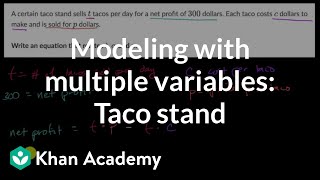 Modeling with multiple variables: Taco stand ✓ Check-ins3:16
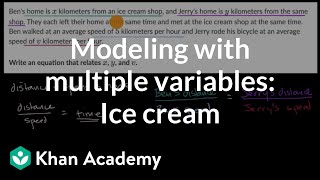 Modeling with multiple variables: Ice cream ✓ Check-ins3:28
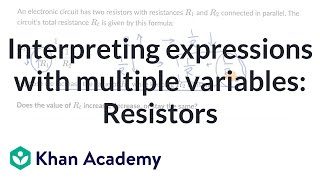 Interpreting expressions with multiple variables: Resistors ✓ Check-ins3:27
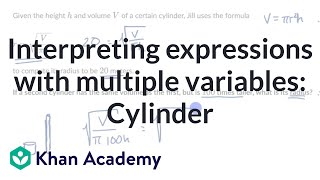 Interpreting expressions with multiple variables: Cylinder ✓ Check-ins3:35
Learn this with a class
With a class on Puzzicle this course runs as a timetable of live study parties: your batch watches together and answers the check-ins, sometimes with a teacher leading.
Course content © Khan Academy, used under CC BY-NC-SA. See this course on Khan Academy.