AP®︎/College Calculus AB
Learn AP®︎ Calculus AB—everything you need to know about limits, derivatives, and integrals to pass the AP® test.
9 units385 videos38 hours
Learn it live with a class on Puzzicle · Teachers: use it with your class
Unit 1: Limits and continuity
About the Course


Define limits and use limit notation
Estimate limit values from graphs
 Estimating limit values from graphs ✓ Check-ins6:01
 Examining unbounded limits ✓ Check-ins2:32
 Estimating one-sided limits from graphs ✓ Check-ins9:11
 Estimating one-sided limits from graphs: asymptote ✓ Check-ins2:27
 Connecting limits and graphical behavior ✓ Check-ins5:03
 Missing function detail when zoomed out ✓ Check-ins ✎ Fixed a slip3:29
 Missing function features when zoomed in3:18
 Finding limit of an oscillating function ✓ Check-ins1:15
Estimate limit values from tables
Determine limits using algebraic properties of limits: limit properties
 Introducing properties of limits ✓ Check-ins5:08
 Determining limits of combined functions ✓ Check-ins4:09
 Determining limits of combined functions: piecewise functions ✓ Check-ins4:13
 Examining the theorem for limits of composite functions ✓ Check-ins3:13
 Examining the theorem for limits of composite functions: when conditions aren't met ✓ Check-ins3:22
 Determining limits of composite functions: internal limit doesn't exist ✓ Check-ins4:17
 Determining limits of composite functions: external limit doesn't exist ✓ Check-ins3:25
Determine limits using algebraic properties of limits: direct substitution
 Finding limits by direct substitution ✓ Check-ins2:07
 Examining undefined limits by direct substitution ✓ Check-ins2:14
 Determining limits of trigonometric functions ✓ Check-ins6:06
 Determining limits of piecewise functions ✓ Check-ins3:49
 Determining limits of piecewise functions: absolute value ✓ Check-ins6:20
Determine limits using algebraic manipulation
Select procedures for determining limits
Determine limits using the squeeze theorem

Explore types of discontinuities
Define continuity at a point
Confirm continuity over an interval
Remove discontinuities
Connect infinite limits and vertical asymptotes
Connect limits at infinity and horizontal asymptotes
 Introducing limits at infinity ✓ Check-ins2:46
 Exploring functions with same limit at infinity ✓ Check-ins3:46
 Determining limits at infinity of quotients (Part 1) ✓ Check-ins4:07
 Determining limits at infinity of quotients (Part 2) ✓ Check-ins4:33
 Determining limits at infinity of quotients with square roots (odd power) ✓ Check-ins5:14
 Determining limits at infinity of quotients with square roots (even power) ✓ Check-ins3:37
Work with the intermediate value theorem
Optional videos
 Exploring the formal definition of limits Part 1: intuition review ✓ Check-ins3:36
 Exploring the formal definition of limits Part 2: building the idea ✓ Check-ins6:06
 Exploring the formal definition of limits Part 3: the definition ✓ Check-ins ✎ Fixed a slip6:59
 Exploring the formal definition of limits Part 4: using the definition ✓ Check-ins8:30
Free response questions: limits and continuity
Unit 2: Differentiation: definition and basic derivative rules
Define average and instantaneous rates of change at a point
 Connecting Newton, Leibniz, and Usain Bolt ✓ Check-ins9:07
 Exploring derivatives as a concept ✓ Check-ins7:16
 Connecting secant lines and average rate of change ✓ Check-ins5:17
 Exploring the derivative as slope of a curve ✓ Check-ins6:10
 Connecting the derivative and tangent line equations ✓ Check-ins7:33
Define the derivative of a function and use derivative notation
 Exploring the formal definition of the derivative as a limit ✓ Check-ins15:43
 Understanding the formal and alternate form of the derivative ✓ Check-ins4:53
 Working an example: Derivative as a limit ✓ Check-ins5:46
 Working an example: Derivative from limit expression ✓ Check-ins5:17
 Finding the derivative of x² at x=3 using the formal definition ✓ Check-ins8:28
 Finding the derivative of x² at any point using the formal definition ✓ Check-ins ✎ Fixed a slip11:05
Estimate derivatives of a function at a point
Connect differentiability and continuity: determine when derivatives do and do not exist
 Exploring differentiability and continuity ✓ Check-ins9:38
 Understanding differentiability at a point: graphical ✓ Check-ins5:39
 Examining differentiability at a point: algebraic (function is differentiable) ✓ Check-ins5:02
 Examining differentiability at a point: algebraic (function isn't differentiable) ✓ Check-ins6:22
Apply the power rule

Derivative rules: constant, sum, difference, and constant multiple: introduction

Derivative rules: constant, sum, difference, and constant multiple: connect with the power rule
Derivatives of cos(x), sin(x), 𝑒ˣ, and ln(x)
Practice to connect derivatives and limits
The product rule
The quotient rule
Find the derivatives of tangent, cotangent, secant, and/or cosecant functions
Optional videos
 Exploring the proof: Differentiability implies continuity ✓ Check-ins11:40
 Justifying the power rule ✓ Check-ins6:42
 Proving the power rule for positive integer powers ✓ Check-ins ✎ Fixed a slip7:03
 Proving the power rule for the square root function ✓ Check-ins5:07
 Determining the limit of sin(x)/x as x approaches 0 ✓ Check-ins9:16
 Determining the limit of (1-cos(x))/x as x approaches 0 ✓ Check-ins4:05
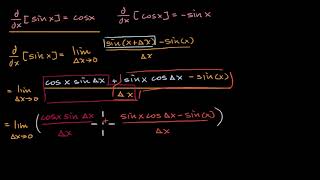 Proving the derivative of sin(x) ✓ Check-ins5:52
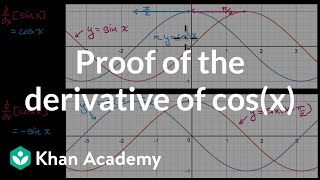 Proving the derivative of cos(x) ✓ Check-ins3:18
 Proving the product rule ✓ Check-ins9:26
Free response questions: differentiation definition and basic derivative rules
 Estimating rate of change 2011 AP Calculus AB free response 2a ✓ Check-ins3:36
 Writing equation of tangent line AP Calculus AB free response 2011 3a ✓ Check-ins2:59
 Estimating rate of change: 2015 AP Calculus AB/BC 3a ✓ Check-ins5:49
 Writing equation of tangent line: 2015 AP Calculus AB 6a ✓ Check-ins ✎ Fixed a slip2:28
 Using the quotient rule, 2016 Calculus AB free response 6b ✓ Check-ins2:53
 Using average rate of change and first derivative, 2018 Calculus AB free response 5a,b ✓ Check-ins3:53
 Relating derivative to tangent line, 2019 Calculus AB free response 6a,b ✓ Check-ins4:12
 Determining when first derivative equals average rate of change, 2025 Calculus AB free response 1b ✓ Check-ins7:07
Unit 3: Differentiation: composite, implicit, and inverse functions
The chain rule: introduction
 Using the chain rule ✓ Check-ins5:07
 Examining common chain rule misunderstandings ✓ Check-ins6:48
 Identifying composite functions ✓ Check-ins8:13
 Working an example: Derivative of cos³(x) using the chain rule ✓ Check-ins9:17
 Working an example: Derivative of √(3x²-x) using the chain rule ✓ Check-ins ✎ Fixed a slip5:31
 Working an example: Derivative of ln(√x) using the chain rule ✓ Check-ins6:45
The chain rule: further practice
 Working an example: Chain rule with table ✓ Check-ins2:27
 Determining the derivative of aˣ (for any positive base a) ✓ Check-ins5:25
 Determining the derivative of logₐx (for any positive base a≠1) ✓ Check-ins4:48
 Working an example: Derivative of 7^(x²-x) using the chain rule ✓ Check-ins3:40
 Working an example: Derivative of log₄(x²+x) using the chain rule ✓ Check-ins4:10
 Working an example: Derivative of sec(3π/2-x) using the chain rule ✓ Check-ins7:11
 Working an example: Derivative of ∜(x³+4x²+7) using the chain rule ✓ Check-ins ✎ Fixed a slip5:55
Implicit differentiation

Differentiate inverse functions
Differentiate inverse trigonometric functions

Select procedures to calculate derivatives: strategy
Select procedures to calculate derivatives: multiple rules
Calculate higher-order derivatives
Optional videos
Free response questions: differentiation of composite, implicit, and inverse functions
Unit 4: Contextual applications of differentiation
Interpret the meaning of the derivative in context
Straight-line motion: connect position, velocity, and acceleration
 Introducing one-dimensional motion with calculus ✓ Check-ins6:31
 Interpreting direction of motion from position-time graph ✓ Check-ins2:39
 Interpreting direction of motion from velocity-time graph ✓ Check-ins1:46
 Interpreting change in speed from velocity-time graph ✓ Check-ins3:57
 Working an example: Motion problems with derivatives ✓ Check-ins4:58
Rates of change in other applied contexts (non-motion problems)
Introduction to related rates
 Introducing related rates ✓ Check-ins7:43
 Analyzing related rates problems: expressions ✓ Check-ins8:07
 Analyzing related rates problems: equations (Pythagoras) ✓ Check-ins3:35
 Analyzing related rates problems: equations (trig) ✓ Check-ins8:01
 Differentiating related functions intro ✓ Check-ins ✎ Fixed a slip3:24
 Working an example: Differentiating related functions ✓ Check-ins7:52
Solve related rates problems

Approximate values of a function using local linearity and linearization
Use L’Hôpital’s rule to find limits of indeterminate forms
Optional videos
Free response questions: contextual applications of differentiation
 Analyzing speed of a particle: 2011 Calculus AB free response #1a ✓ Check-ins7:28
 Using tangent line for approximation: 2011 Calculus AB free response #5a ✓ Check-ins ✎ Fixed a slip6:59
 Estimating rate of change 2015 AP Calculus AB BC 1b ✓ Check-ins3:48
 Finding rate of change: 2015 AP Calculus 2c ✓ Check-ins3:45
 Calculating acceleration AP Calculus AB BC 2015 3c ✓ Check-ins1:46
 Differentiating implicitly: 2015 AP Calculus AB 6c ✓ Check-ins ✎ Fixed a slip6:17
 Writing and using equation of tangent line: 2017 AP Calculus AB/BC 4a ✓ Check-ins6:08
Unit 5: Analytical applications of differentiation
Use the mean value theorem
 Introducing the mean value theorem ✓ Check-ins6:37
 Applying the mean value theorem example: polynomial ✓ Check-ins4:50
 Applying the mean value theorem example: square root function ✓ Check-ins6:24
 Justifying use of the mean value theorem: table ✓ Check-ins3:41
 Justifying use of the mean value theorem: equation ✓ Check-ins2:54
 Applying the mean value theorem ✓ Check-ins7:12
Extreme value theorem, global versus local extrema, and critical points
Determine intervals on which a function increases or decreases
Use the first derivative test to find relative (local) extrema
 Introducing minimum and maximum points ✓ Check-ins5:30
 Finding relative extrema (first derivative test) ✓ Check-ins5:25
 Working an example: finding relative extrema ✓ Check-ins7:49
 Analyzing mistakes when finding extrema (example 1) ✓ Check-ins4:33
 Analyzing mistakes when finding extrema (example 2) ✓ Check-ins4:42
Use the candidates test to find absolute (global) extrema
Determine concavity of intervals and find points of inflection: graphical
Determine concavity of intervals and find points of inflection: algebraic
 Analyzing concavity (algebraic) ✓ Check-ins ✎ Fixed a slip9:16
 Analyzing inflection points (algebraic) ✓ Check-ins ✎ Fixed a slip5:35
 Exploring mistakes when finding inflection points: second derivative undefined ✓ Check-ins6:11
 Exploring mistakes when finding inflection points: not checking candidates ✓ Check-ins4:02
Use the second derivative test to find extrema
Sketch curves of functions and their derivatives
Connect a function, its first derivative, and its second derivative
 Establishing a calculus-based justification for a function increasing ✓ Check-ins3:12
 Justifying a function's features using the first derivative ✓ Check-ins5:53
 Identifying inflection points from graphs of function and derivatives ✓ Check-ins5:06
 Justifying a function's features using the second derivative: inflection point ✓ Check-ins3:47
 Justifying a function's features using the second derivative: maximum point ✓ Check-ins ✎ Fixed a slip4:14
 Connecting f, f', and f'' graphically ✓ Check-ins5:36
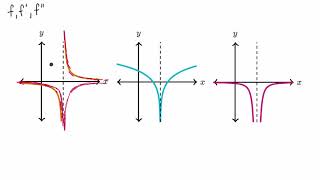 Connecting f, f', and f'' graphically (another example) ✓ Check-ins4:21
Solve optimization problems
 Applying optimization: sum of squares ✓ Check-ins ✎ Fixed a slip7:35
 Applying optimization: box volume (Part 1) ✓ Check-ins9:50
 Applying optimization: box volume (Part 2) ✓ Check-ins9:00
 Applying optimization: profit ✓ Check-ins ✎ Fixed a slip11:27
 Applying optimization: cost of materials ✓ Check-ins ✎ Fixed a slip12:40
 Applying optimization: area of triangle & square (Part 1) ✓ Check-ins ✎ Fixed a slip6:19
 Applying optimization: area of triangle & square (Part 2) ✓ Check-ins5:31
 Analyzing motion problems: finding the maximum acceleration ✓ Check-ins4:25
Explore behaviors of implicit relations
Free response questions: analytical applications of differentiation
 Using the Mean Value Theorem: 2011 Calculus AB free response #4d ✓ Check-ins ✎ Fixed a slip5:46
 Finding relative maximum: 2015 AP Calculus AB 5a ✓ Check-ins ✎ Fixed a slip4:35
 Analyzing function features: 2015 AP Calculus AB 5b ✓ Check-ins3:01
 Finding inflection points: 2015 AP Calculus AB 5c ✓ Check-ins ✎ Fixed a slip3:16
 Finding vertical tangent lines: 2015 AP Calculus AB 6b ✓ Check-ins4:42
 Using concavity for reasoning: 2017 AP Calculus AB/BC 4b ✓ Check-ins5:12
Unit 6: Integration and accumulation of change
Explore accumulations of change

Approximate areas with Riemann sums
 Introducing Riemann approximations ✓ Check-ins ✎ Fixed a slip6:45
 Over- and under-estimating of Riemann sums ✓ Check-ins4:01
 Working an example: finding a Riemann sum using a table ✓ Check-ins6:39
 Working an example: over- and under-estimation of Riemann sums ✓ Check-ins4:42
 Approximating area using midpoint sums ✓ Check-ins5:29
 Approximating area using trapezoidal sums ✓ Check-ins8:27
Riemann sums, summation notation, and definite integral notation
 Understanding summation notation ✓ Check-ins4:27
 Working examples: Summation notation ✓ Check-ins5:21
 Using Riemann sums in summation notation ✓ Check-ins8:31
 Working an example: Riemann sums in summation notation ✓ Check-ins ✎ Fixed a slip7:07
 Representing a definite integral as the limit of a Riemann sum ✓ Check-ins4:26
 Working an example: Rewriting definite integral as limit of Riemann sum ✓ Check-ins5:34
 Working an example: Rewriting limit of Riemann sum as definite integral ✓ Check-ins6:35
The fundamental theorem of calculus and accumulation functions
 Introducing the fundamental theorem of calculus and accumulation functions ✓ Check-ins ✎ Fixed a slip8:03
 Understanding functions defined by definite integrals (accumulation functions) ✓ Check-ins4:17
 Finding derivative with fundamental theorem of calculus ✓ Check-ins3:24
 Finding derivative with fundamental theorem of calculus: chain rule ✓ Check-ins3:07
Interpret the behavior of accumulation functions that involve area
Apply properties of definite integrals
 Understanding definite integrals with a negative value ✓ Check-ins5:24
 Finding definite integrals using area formulas ✓ Check-ins4:17
 Calculating net area using geometry ✓ Check-ins4:02
 Evaluating a definite integral over a single point ✓ Check-ins2:31
 Integrating scaled version of function ✓ Check-ins5:21
 Switching bounds of definite integral ✓ Check-ins4:37
 Integrating sums of functions ✓ Check-ins6:46
 Working examples: Finding definite integrals using algebraic properties ✓ Check-ins2:19
 Evaluating definite integrals on adjacent intervals ✓ Check-ins3:06
 Working an example: Breaking up the integral's interval ✓ Check-ins ✎ Fixed a slip7:25
 Working an example: Merging definite integrals over adjacent intervals ✓ Check-ins4:02
 Evaluating functions defined by integrals: switched interval ✓ Check-ins2:54
 Finding derivative with fundamental theorem of calculus: x is on lower bound ✓ Check-ins3:00
 Finding derivative with fundamental theorem of calculus: x is on both bounds ✓ Check-ins5:04
The fundamental theorem of calculus and definite integrals
Find antiderivatives and integrals: basic rules and notation: reverse power rule
Find antiderivatives and integrals: basic rules and notation: common indefinite integrals
Find antiderivatives and integrals: basic rules and notation: definite integrals
 Evaluating definite integrals: reverse power rule ✓ Check-ins4:14
 Evaluating definite integral of a rational function ✓ Check-ins5:05
 Evaluating definite integral of a radical function ✓ Check-ins3:51
 Evaluating definite integral of a trig function ✓ Check-ins5:00
 Evaluating definite integral involving a natural log function ✓ Check-ins7:27
 Evaluating definite integral of a piecewise function ✓ Check-ins6:14
 Evaluating definite integral of an absolute value function ✓ Check-ins6:53
 Evaluating definite integral of function with removable and jump discontinuities ✓ Check-ins ✎ Fixed a slip7:10
Integrate using substitution
 Introducing 𝘶-substitution ✓ Check-ins5:11
 Using 𝘶-substitution: multiplying by a constant ✓ Check-ins5:33
 Using 𝘶-substitution: defining 𝘶 ✓ Check-ins3:35
 Using 𝘶-substitution: defining 𝘶 (more examples) ✓ Check-ins4:34
 Using 𝘶-substitution: rational function ✓ Check-ins4:04
 Using 𝘶-substitution: logarithmic function ✓ Check-ins3:39
 Using 𝘶-substitution: definite integrals ✓ Check-ins5:53
 Using 𝘶-substitution: definite integral of exponential function ✓ Check-ins ✎ Fixed a slip7:53
Complete the square or use long division to integrate functions
Optional videos
Free response questions: integration and accumulation of change
Unit 7: Differential equations
Model situations with differential equations
Verify solutions for differential equations
Sketch slope fields
Draw conclusion from slope fields
Use separation of variables to find general solutions
Use initial conditions and separation of variables to find particular solutions
 Finding particular solutions to differential equations: rational function ✓ Check-ins ✎ Fixed a slip4:24
 Finding particular solutions to differential equations: exponential function ✓ Check-ins3:08
 Working an example: finding a specific solution to a separable equation ✓ Check-ins5:38
 Working an example: separable equation with an implicit solution ✓ Check-ins3:18
 Determining the domain of particular solution to differential equation ✓ Check-ins3:48
Exponential models with differential equations
Free response questions: differential equations
Unit 8: Applications of integration
Find the average value of a function on an interval
Connect position, velocity, and acceleration functions using integrals
 Solving motion problems with integrals: displacement vs. distance ✓ Check-ins8:04
 Analyzing motion problems: position ✓ Check-ins2:56
 Analyzing motion problems: total distance traveled ✓ Check-ins2:53
 Working an example: motion problems (with definite integrals) ✓ Check-ins ✎ Fixed a slip8:32
 Finding the average acceleration over interval ✓ Check-ins5:07
Use accumulation functions and definite integrals in applied contexts
 Determining area under rate function gives the net change ✓ Check-ins7:27
 Interpreting definite integral as net change ✓ Check-ins5:16
 Working examples: interpreting definite integrals in context ✓ Check-ins4:21
 Analyzing problems involving definite integrals ✓ Check-ins5:52
 Working an example: problem involving definite integral (algebraic) ✓ Check-ins7:50
Find the area between curves expressed as functions of x
 Calculating area between a curve and the x-axis ✓ Check-ins5:54
 Calculating area between a curve and the x-axis: negative area ✓ Check-ins7:28
 Calculating the area between curves ✓ Check-ins6:50
 Working an example: area between curves ✓ Check-ins ✎ Fixed a slip5:25
 Calculating the composite area between curves ✓ Check-ins6:54
Find the area between curves expressed as functions of y
Find the area between curves that intersect at more than two points
Volumes with cross sections: squares and rectangles
Volumes with cross sections: triangles and semicircles
Volume with disc method: revolve around x- or y-axis

Volume with disc method: revolve around other axes
Volume with washer method: revolve around x- or y-axis
Volume with washer method: revolve around other axes
 Using the washer method: rotating around horizontal line (not x-axis), part 1 ✓ Check-ins6:38
 Using the washer method: rotating around horizontal line (not x-axis), part 2 ✓ Check-ins8:14
 Using the washer method: rotating around vertical line (not y-axis), part 1 ✓ Check-ins7:50
 Using the washer method: rotating around vertical line (not y-axis), part 2 ✓ Check-ins5:35
Free response questions: applications of integration
 Using integrals to analyze particle motion: 2011 Calculus AB Free Response #1 (b, c, & d) ✓ Check-ins8:04
 Applying second fundamental theorem of calculus: 2011 Calculus AB free response #2 (c & d) ✓ Check-ins ✎ Fixed a slip7:27
 Calculating area between curves AP Calculus AB free response 2011 3b ✓ Check-ins5:15
 Writing integral for solid of revolution: 2011 Calculus AB free response #3 (c) ✓ Check-ins6:39
 Finding average value: 2011 Calculus AB free response #6c ✓ Check-ins7:29
 Using accumulation functions 2015 AP Calculus AB BC 1a ✓ Check-ins4:45
 Writing integral to solve problem in context: 2015 AP Calculus AB/BC 1d ✓ Check-ins3:19
 Finding area between curves: 2015 AP Calculus AB 2a ✓ Check-ins4:55
 Finding volume of solid with known cross section: 2015 AP Calculus AB 2b ✓ Check-ins6:27
 Finding average velocity 2015 AP Calculus AB BC 3d ✓ Check-ins3:20
 Using function that involves an integral: 2015 AP Calculus AB 5d ✓ Check-ins5:29
Unit 9: Free response questions for AP Calculus AB from multiple units
Free response questions that involve concepts from multiple units
Learn this with a class
With a class on Puzzicle this course runs as a timetable of live study parties: your batch watches together and answers the check-ins, sometimes with a teacher leading.
Course content © Khan Academy, used under CC BY-NC-SA. See this course on Khan Academy.