AP®︎/College Precalculus
Master AP Precalculus! Get ready to build a deep understanding of functions, trigonometry, and vectors. To get oriented, explore the final two units for comprehensive course overview and helpful prerequisite review articles.
4 units173 videos17 hours
Learn it live with a class on Puzzicle · Teachers: use it with your class
Unit 1: Polynomial and rational functions
Change in tandem
Rates of change
Rates of change in linear and quadratic functions
 Connecting secant lines and average rate of change ✓ Check-ins5:17
 Average rate of change word problem: table ✓ Check-ins3:40
 Average rate of change word problem: graph ✓ Check-ins6:58
 Connecting average rates of change with the concavity of a graph ✓ Check-ins3:38
 Describing the average rate of change using the concavity of the graph ✓ Check-ins2:00
Polynomial functions and rates of change
Polynomial functions and complex zeros
 Zeros of polynomials (with factoring): grouping ✓ Check-ins4:55
 Zeros of polynomials (with factoring): common factor ✓ Check-ins3:32
 Zeros of polynomials (multiplicity) ✓ Check-ins5:00
 Solving quadratic equations: complex roots ✓ Check-ins10:15
 Factoring higher degree polynomials ✓ Check-ins3:58
 Factoring higher degree polynomials: Common factor ✓ Check-ins3:39
 Applying the rational root theorem ✓ Check-ins ✎ Fixed a slip7:35
 Even and odd functions: Equations ✓ Check-ins3:56
Polynomial functions and end behavior
Rational functions and end behavior
Rational functions and zeros
Rational functions and vertical asymptotes
Rational functions and holes
Equivalent representations of polynomial and rational expressions
 Completing the square ✓ Check-ins14:06
 Worked example: completing the square (leading coefficient ≠ 1) ✓ Check-ins5:44
 Understanding equivalent forms of polynomial functions to answer questions in context ✓ Check-ins5:13
 Understanding equivalent forms of rational functions to answer questions in context ✓ Check-ins3:39
 Connecting equivalent forms of rational functions ✓ Check-ins9:01
 Factoring using polynomial division ✓ Check-ins5:58
 Factoring using polynomial division: missing term ✓ Check-ins3:58
 Estimating an oblique asymptote graphically ✓ Check-ins1:49
 Finding oblique asymptotes of a rational function ✓ Check-ins5:16
 Intro to the Binomial Theorem ✓ Check-ins13:15
 Pascal's triangle and binomial expansion ✓ Check-ins8:20
 Expanding binomials ✓ Check-ins8:41
Transformations of functions
Function model selection and assumption articulation
Function model construction and application
 Quadratic word problem: ball ✓ Check-ins5:53
 Finding the vertex of a parabola in standard form ✓ Check-ins5:40
 Constructing rational function models ✓ Check-ins2:17
 Graphs of nonlinear piecewise functions ✓ Check-ins4:23
 Graph interpretation word problem: temperature ✓ Check-ins3:55
 Graph interpretation word problem: basketball ✓ Check-ins3:50
 Rational equations word problem: combined rates ✓ Check-ins5:26
 Rational equations word problem: combined rates (example 2) ✓ Check-ins6:00
 Constructing models of data sets using technology and regressions ✓ Check-ins6:17
Unit 2: Exponential and logarithmic functions
Change in arithmetic and geometric sequences
Exponential functions
Exponential function manipulation
Exponential function context and data modeling
Competing function model validation
Composition of functions
 Intro to composing functions ✓ Check-ins6:15
 Evaluating composite functions ✓ Check-ins4:10
 Evaluating composite functions: using tables ✓ Check-ins4:10
 Evaluating composite functions: using graphs ✓ Check-ins3:02
 Evaluating composite functions (advanced) ✓ Check-ins4:11
 Finding composite functions ✓ Check-ins2:57
 Identifying composite functions ✓ Check-ins8:13
Inverse functions
 Reading inverse values from a graph ✓ Check-ins4:14
 Reading inverse values from a table ✓ Check-ins2:08
 Determining if a function is invertible ✓ Check-ins4:04
 Restricting domains of functions to make them invertible ✓ Check-ins6:00
 Verifying inverse functions from tables ✓ Check-ins4:32
 Verifying inverse functions by composition ✓ Check-ins6:41
 Verifying inverse functions by composition: not inverse ✓ Check-ins4:12
 Finding inverses of rational functions ✓ Check-ins4:17
 Finding and interpreting inverse functions ✓ Check-ins2:58
Logarithmic expressions
Inverses of exponential functions
Logarithmic function manipulation
Exponential and logarithmic equations and inequalities
 Solving logarithmic equations ✓ Check-ins2:05
 Logarithmic equations: variable in the base ✓ Check-ins3:28
 Logarithmic equations: variable in the argument ✓ Check-ins4:13
 Solving exponential equations using logarithms: base-10 ✓ Check-ins2:51
 Solving exponential equations using logarithms: base-2 ✓ Check-ins5:12
Logarithmic function context and data modeling
Unit 3: Trigonometric and polar functions
Periodic phenomena
Sine, cosine and tangent
 Radians & degrees ✓ Check-ins7:12
 Identifying reference angles of positive angles in standard position ✓ Check-ins ✎ Fixed a slip4:36
 Identifying reference angles for negative angles in standard position ✓ Check-ins3:26
 Evaluating trigonometric angles in standard position ✓ Check-ins ✎ Fixed a slip3:36
Sine and cosine function values
Sinusoidal function transformations
Sinusoidal function context and data modeling
The tangent function
Inverse trigonometric functions
Trigonometric equations and inequalities
The secant, cosecant, and cotangent functions
Equivalent representations of trigonometric functions
Trigonometry and polar coordinates
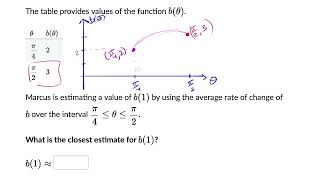
Polar function graphs
Unit 4: Functions involving parametric vectors and matrices
Parametric functions
Parametric functions modeling planar motion and rates of change
Parametrically defined circles and lines
Conic sections
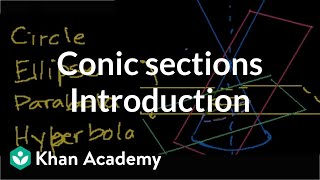 Intro to conic sections ✓ Check-ins10:58
 Writing standard equation of a circle ✓ Check-ins5:40
 Intro to ellipses ✓ Check-ins14:14
 Writing the equation of an ellipse from graph ✓ Check-ins3:25
 Equation of a parabola from focus & directrix ✓ Check-ins9:48
 Intro to focus & directrix ✓ Check-ins4:07
 Intro to hyperbolas ✓ Check-ins13:34
 Vertices & direction of a hyperbola ✓ Check-ins5:15
 Foci of a hyperbola from equation ✓ Check-ins15:24
 Equation of a hyperbola not centered at the origin ✓ Check-ins10:29
Parameterization of implicitly defined functions
Vectors
 Intro to vectors and scalars ✓ Check-ins8:39
 Representing quantities with vectors ✓ Check-ins2:46
 Interpreting statements about vectors ✓ Check-ins2:38
 Introduction to vector components ✓ Check-ins5:16
 Finding the components of a vector ✓ Check-ins3:18
 Comparing the components of vectors ✓ Check-ins2:55
 Vector magnitude from graph ✓ Check-ins3:38
 Vector magnitude from components ✓ Check-ins3:06
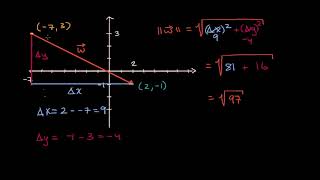 Vector magnitude from initial & terminal points ✓ Check-ins5:23
 Adding & subtracting vectors ✓ Check-ins7:42
 Adding & subtracting vectors end-to-end ✓ Check-ins6:22
 Vector addition & magnitude ✓ Check-ins5:30
 Adding vectors in magnitude and direction form ✓ Check-ins8:21
 Scalar multiplication: magnitude and direction ✓ Check-ins4:53
 Scalar multiplication: component form ✓ Check-ins5:42
 Unit vectors intro ✓ Check-ins ✎ Fixed a slip7:59
The inverse and determinant of a matrix
Linear transformation and matrices
Learn this with a class
With a class on Puzzicle this course runs as a timetable of live study parties: your batch watches together and answers the check-ins, sometimes with a teacher leading.
Course content © Khan Academy, used under CC BY-NC-SA. See this course on Khan Academy.