Algebra 2 (Eureka Math/EngageNY)
Learn Algebra 2 aligned to the Eureka Math/EngageNY curriculum —polynomials, rational functions, trigonometry, and more.
4 units267 videos27 hours
Learn it live with a class on Puzzicle · Teachers: use it with your class
Unit 1: Module 1: Polynomial, rational, and radical relationships
Topic A: Polynomials—from base ten to base X
 Multiplying binomials by polynomials: area model ✓ Check-ins6:30
 Multiplying binomials by polynomials ✓ Check-ins2:34
 Intro to long division of polynomials ✓ Check-ins12:09
 Dividing polynomials: long division ✓ Check-ins3:20
 Divide polynomials by x (with remainders) ✓ Check-ins4:45
 Divide polynomials by monomials (with remainders) ✓ Check-ins2:41
 Dividing polynomials with remainders ✓ Check-ins ✎ Fixed a slip6:23
 Simplifying square roots ✓ Check-ins3:09
 Simplifying square roots (variables) ✓ Check-ins4:16
Topic B: Lessons 12-13: Factorization
 Factoring quadratics: common factor + grouping ✓ Check-ins4:46
 Factoring quadratics: negative common factor + grouping ✓ Check-ins5:17
 Factoring two-variable quadratics ✓ Check-ins6:11
 Factoring two-variable quadratics: rearranging ✓ Check-ins2:46
 Factoring two-variable quadratics: grouping ✓ Check-ins3:46
 Factoring using the perfect square pattern ✓ Check-ins2:25
 Factoring using the difference of squares pattern ✓ Check-ins1:49
 Factoring difference of squares: two variables (example 2) ✓ Check-ins2:30
 Factoring higher-degree polynomials ✓ Check-ins8:02
 Factoring sum of cubes ✓ Check-ins4:46
 Factoring difference of cubes ✓ Check-ins4:12
 Finding zeros of polynomials (1 of 2) ✓ Check-ins9:09
 Finding zeros of polynomials (2 of 2) ✓ Check-ins3:00
 Finding zeros of polynomials (example 2) ✓ Check-ins ✎ Fixed a slip6:45
Topic B: Lesson 14: Graphing factored polynomials
Topic B: Lesson 15: Structure in graphs of polynomial functions
Topic B: Lessons 16-21: Remainder theorem and modeling
Topic C: Lessons 22-23: Simplifying rational expressions
 Reducing rational expressions to lowest terms ✓ Check-ins15:22
 Simplifying rational expressions: common monomial factors ✓ Check-ins6:59
 Simplifying rational expressions: common binomial factors ✓ Check-ins4:11
 Simplifying rational expressions: opposite common binomial factors ✓ Check-ins3:53
 Simplifying rational expressions: grouping ✓ Check-ins6:42
 Simplifying rational expressions: higher degree terms ✓ Check-ins5:53
 Simplifying rational expressions: two variables ✓ Check-ins6:11
Topic C: Lesson 24: Multiplying and dividing rational expressions
 Multiplying & dividing rational expressions: monomials ✓ Check-ins5:56
 Multiplying rational expressions ✓ Check-ins4:52
 Dividing rational expressions ✓ Check-ins ✎ Fixed a slip4:10
 Multiplying rational expressions: multiple variables ✓ Check-ins3:38
 Dividing rational expressions: unknown expression ✓ Check-ins6:02
Topic C: Lesson 25: Adding and subtracting rational expressions
 Adding & subtracting rational expressions: like denominators ✓ Check-ins3:45
 Intro to adding rational expressions with unlike denominators ✓ Check-ins2:44
 Adding rational expression: unlike denominators ✓ Check-ins5:11
 Subtracting rational expressions: unlike denominators ✓ Check-ins4:47
 Least common multiple ✓ Check-ins4:16
 Least common multiple: repeating factors ✓ Check-ins2:35
 Subtracting rational expressions: factored denominators ✓ Check-ins4:48
 Least common multiple of polynomials ✓ Check-ins6:52
 Subtracting rational expressions ✓ Check-ins4:36
 Nested fractions ✓ Check-ins5:46
Topic C: Lessons 26-27: Rational equations
 Rational equations intro ✓ Check-ins3:12
 Equations with one rational expression (advanced) ✓ Check-ins4:32
 Equations with rational expressions ✓ Check-ins5:12
 Equations with rational expressions (example 2) ✓ Check-ins7:12
 Rational equations word problem: combined rates ✓ Check-ins5:26
 Rational equations word problem: combined rates (example 2) ✓ Check-ins6:00
 Rational equations word problem: eliminating solutions ✓ Check-ins7:59
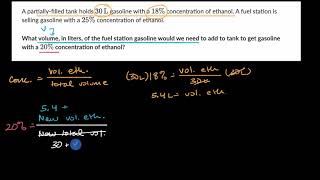 Combining mixtures example ✓ Check-ins5:48
Topic C: Lessons 28-29: Radical equations
 Intro to square-root equations & extraneous solutions ✓ Check-ins11:10
 Solving square-root equations: one solution ✓ Check-ins3:11
 Solving square-root equations: two solutions ✓ Check-ins5:29
 Solving square-root equations: no solution ✓ Check-ins3:59
 Square-root equations intro ✓ Check-ins5:23
 Equation that has a specific extraneous solution ✓ Check-ins4:57
 Solving cube-root equations ✓ Check-ins3:34
Topic C: Lesson 30: Linear systems in three variables
Topic C: Lesson 31: Systems of equations
Topic C: Lesson 32: Graphing systems of equations
Topic C: Lessons 33-35: Parabolas
Topic D: Lesson 37: Complex numbers intro
Topic D: Lesson 37: Complex number operations
Topic D: Lessons 38-40: Complex roots and the fundamental theorem of algebra
 Solving quadratic equations: complex roots ✓ Check-ins10:15
 Complex numbers & sum of squares factorization ✓ Check-ins4:51
 Factoring sum of squares ✓ Check-ins2:32
 The Fundamental theorem of Algebra ✓ Check-ins5:34
 Quadratics & the Fundamental Theorem of Algebra ✓ Check-ins6:35
 Number of possible real roots of a polynomial ✓ Check-ins3:46
Unit 2: Module 2: Trigonometric functions
Topic A: Lessons 1-7: Unit circle definition of trig functions
 Unit circle ✓ Check-ins9:04
 The trig functions & right triangle trig ratios ✓ Check-ins6:57
 Trig values of π/4 ✓ Check-ins7:54
 Sine & cosine identities: symmetry ✓ Check-ins7:58
 Sine & cosine identities: periodicity ✓ Check-ins6:13
 Tangent identities: symmetry ✓ Check-ins7:15
 Tangent identities: periodicity ✓ Check-ins4:02
 Finding reciprocal trig ratios ✓ Check-ins4:45
 Using reciprocal trig ratios ✓ Check-ins6:12
Topic A: Lessons 8-10: Trigonometric graphs and radians
Topic B: Lesson 11: Graphing sinusoidal functions
Topic B: Lesson 11: Features of sinusoidal graphs
Topic B: Lessons 12-13: Modeling with sinusoidal functions
Topic B: Lesson 14: Graphing the tangent function
Topic B: Lessons 15-17: Trigonometric identities
 Proof of the Pythagorean trig identity ✓ Check-ins6:12
 Using the Pythagorean trig identity ✓ Check-ins6:15
 Trig angle addition identities ✓ Check-ins11:07
 Using the cosine angle addition identity ✓ Check-ins5:14
 Using the cosine double-angle identity ✓ Check-ins3:28
 Proof of the sine angle addition identity ✓ Check-ins8:26
 Proof of the cosine angle addition identity ✓ Check-ins6:02
Unit 3: Module 3: Exponential and logarithmic functions
Topic A: Lesson 1: Integer exponents
Topic A: Lesson 2: Scientific notation
 Scientific notation example: 0.0000000003457 ✓ Check-ins4:12
 Scientific notation examples ✓ Check-ins11:26
 Multiplying & dividing in scientific notation ✓ Check-ins2:53
 Multiplying three numbers in scientific notation ✓ Check-ins7:35
 Subtracting in scientific notation ✓ Check-ins4:13
 Scientific notation word problem: red blood cells ✓ Check-ins4:46
 Scientific notation word problem: U.S. national debt ✓ Check-ins6:21
 Scientific notation word problem: speed of light ✓ Check-ins4:27
Topic A: Lessons 3-6: Rational exponents
Topic B: Lessons 7-9: Logarithms intro
Topic B: Lessons 10-12: Logarithm properties
 Intro to logarithm properties (1 of 2) ✓ Check-ins9:16
 Intro to logarithm properties (2 of 2) ✓ Check-ins10:04
 Using the logarithmic product rule ✓ Check-ins5:04
 Using the logarithmic power rule ✓ Check-ins4:49
 Using the properties of logarithms: multiple steps ✓ Check-ins2:10
 Proof of the logarithm product rule ✓ Check-ins7:08
 Proof of the logarithm quotient and power rules ✓ Check-ins7:59
Topic B: Lesson 13: Changing the base
Topic B: Lessons 13-15: Logarithms and equations
Topic C: Lesson 16: Rational and Irrational Numbers
 Approximating square roots ✓ Check-ins4:48
 Comparing irrational numbers with radicals ✓ Check-ins5:29
 Approximating square roots to hundredths ✓ Check-ins7:12
 Comparing values with calculator ✓ Check-ins4:01
 Proof: sum & product of two rationals is rational ✓ Check-ins2:46
 Proof: product of rational & irrational is irrational ✓ Check-ins3:15
 Proof: sum of rational & irrational is irrational ✓ Check-ins3:24
 Sums and products of irrational numbers ✓ Check-ins5:57
 Worked example: rational vs. irrational expressions ✓ Check-ins2:36
 Worked example: rational vs. irrational expressions (unknowns) ✓ Check-ins6:26
Topic C: Lessons 17-22: Graphs of exponential and logarithmic functions
 Relationship between exponentials & logarithms ✓ Check-ins1:42
 Relationship between exponentials & logarithms: graphs ✓ Check-ins4:10
 Relationship between exponentials & logarithms: tables ✓ Check-ins5:59
 Transforming exponential graphs ✓ Check-ins3:05
 Transforming exponential graphs (example 2) ✓ Check-ins5:18
 Graphing exponential functions ✓ Check-ins3:15
 Graphical relationship between 2ˣ and log₂(x) ✓ Check-ins5:42
 Shape of a logarithmic parent graph ✓ Check-ins9:10
 Graphs of logarithmic functions ✓ Check-ins6:28
Topic D: Lessons 23-24: Solving exponential models
Topic D: Lessons 25-28: Modeling with exponential functions
 Interpreting change in exponential models ✓ Check-ins6:54
 Interpreting time in exponential models ✓ Check-ins6:43
 Constructing exponential models ✓ Check-ins3:48
 Constructing exponential models: half life ✓ Check-ins4:18
 Constructing exponential models: percent change ✓ Check-ins4:52
 Interpreting change in exponential models: with manipulation ✓ Check-ins4:21
 Interpreting change in exponential models: changing units ✓ Check-ins4:22
Topic E: Lesson 29: Geometric series
 Understanding summation notation ✓ Check-ins4:27
 Geometric series intro ✓ Check-ins2:53
 Geometric series with sigma notation ✓ Check-ins4:28
 Finite geometric series formula ✓ Check-ins7:15
 Worked example: finite geometric series (sigma notation) ✓ Check-ins2:48
 Worked examples: finite geometric series ✓ Check-ins6:55
 Finite geometric series word problem: social media ✓ Check-ins8:03
 Finite geometric series word problem: mortgage ✓ Check-ins17:36
Topic E: Lesson 29: Arithmetic series
 Arithmetic series intro ✓ Check-ins3:56
 Arithmetic series formula ✓ Check-ins7:47
 Worked example: arithmetic series (sigma notation) ✓ Check-ins7:02
 Worked example: arithmetic series (sum expression) ✓ Check-ins6:47
 Worked example: arithmetic series (recursive formula) ✓ Check-ins5:21
 Proof of finite arithmetic series formula ✓ Check-ins3:32
Unit 4: Module 4: Inferences and conclusions from data
Topic A: Lesson 1: Chance experiments, sample spaces, and events
Topic A: Lessons 2-4: Two-way tables, conditional probability, and independence
Topic A: Lessons 5-7: Venn diagrams and probability rules
 Intersection and union of sets ✓ Check-ins7:44
 Compound probability of independent events ✓ Check-ins6:00
 Independent events example: test taking ✓ Check-ins4:44
 "At least one" probability with coin flipping ✓ Check-ins9:20
 Probability with Venn diagrams ✓ Check-ins10:02
 Addition rule for probability ✓ Check-ins10:43
Topic B: Lesson 8: Distributions—Center, shape, and spread
 Shapes of distributions ✓ Check-ins5:07
 Comparing means of distributions ✓ Check-ins ✎ Fixed a slip7:49
 Means and medians of different distributions ✓ Check-ins6:29
 Mean and standard deviation versus median and IQR ✓ Check-ins7:59
 Population standard deviation ✓ Check-ins8:05
 Sample standard deviation and bias ✓ Check-ins9:33
Topic B: Lesson 9: Using a curve to model a data distribution
Topic B: Lessons 10-11: Normal distributions
 Normal distribution problem: z-scores (from ck12.org) ✓ Check-ins ✎ Fixed a slip7:48
 Comparing with z-scores ✓ Check-ins3:30
 Qualitative sense of normal distributions ✓ Check-ins10:53
 Normal distribution problems: Empirical rule ✓ Check-ins10:25
 Standard normal table for proportion below ✓ Check-ins4:20
 Standard normal table for proportion above ✓ Check-ins5:07
 Standard normal table for proportion between values ✓ Check-ins7:10
Topic C: Lesson 12: Types of statistical studies
Topic C: Lesson 13: Using sample data to estimate a population characteristic
Topic C: Lessons 14-17: Sample proportions, sampling variability, margin of error
Topic C: Lessons 18-19: Sampling variability in the sample mean
Topic C: Lessons 20-22: Margin of error with sample means; evaluating reports with sample data
Topic D: Lesson 23: Experiments and the role of random assignment
Topic D: Lessons 24-27: Ruling out differences due to random assignment
Learn this with a class
With a class on Puzzicle this course runs as a timetable of live study parties: your batch watches together and answers the check-ins, sometimes with a teacher leading.
Course content © Khan Academy, used under CC BY-NC-SA. See this course on Khan Academy.