Integrated math 2
The Mathematics 2 course, often taught in the 10th grade, covers Quadratic equations, functions, and graphs; Complex numbers; Rational exponents and exponential models; Similarity and Trigonometry; Solids; Circles and other Conic sections; and introductory Probability. Khan Academy's Mathematics 2 course is built to deliver a comprehensive, illuminating, engaging, and Common Core aligned experience!
13 units258 videos25 hours
Learn it live with a class on Puzzicle · Teachers: use it with your class
Unit 1: Absolute value & piecewise functions
Graphs of absolute value functions
Piecewise functions
 Introduction to piecewise functions ✓ Check-ins3:49
 Worked example: evaluating piecewise functions ✓ Check-ins4:24
 Worked example: graphing piecewise functions ✓ Check-ins4:30
 Worked example: domain & range of step function ✓ Check-ins2:44
 Worked example: domain & range of piecewise linear functions ✓ Check-ins7:25
Unit 2: Quadratics: Multiplying & factoring
Multiplying monomials by polynomials
Multiplying binomials
Special products of binomials
Introduction to factoring
Factoring quadratics intro
Factoring quadratics by grouping
Factoring quadratics with difference of squares
Factoring quadratics with perfect squares
 Perfect square factorization intro ✓ Check-ins5:19
 Factoring perfect squares ✓ Check-ins4:54
 Identifying perfect square form ✓ Check-ins4:37
 Factoring perfect squares: negative common factor ✓ Check-ins3:52
 Factoring perfect squares: missing values ✓ Check-ins2:39
 Factoring perfect squares: shared factors ✓ Check-ins4:26
Strategy in factoring quadratics
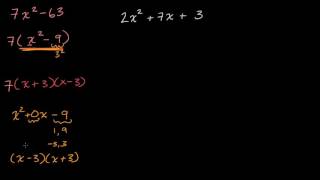
Unit 3: Quadratic functions & equations
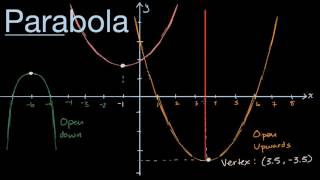
Intro to parabolas
Solving and graphing with factored form
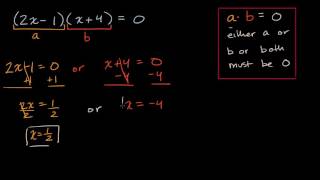
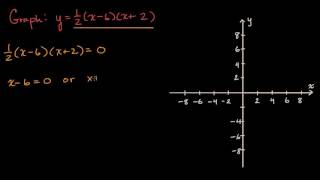
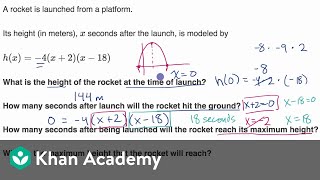
Solving by taking the square root
Vertex form
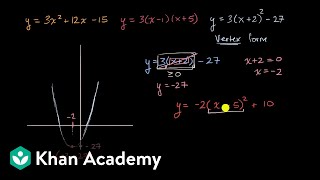
Solving quadratics by factoring
 Solving quadratics by factoring ✓ Check-ins6:22
 Solving quadratics by factoring: leading coefficient ≠ 1 ✓ Check-ins4:35
 Solving quadratics using structure ✓ Check-ins3:55
 Quadratic equations word problem: triangle dimensions ✓ Check-ins8:21
 Quadratic equations word problem: box dimensions ✓ Check-ins5:54
The quadratic formula
Completing the square
 Completing the square ✓ Check-ins14:06
 Worked example: Completing the square (intro) ✓ Check-ins3:22
 Worked example: Rewriting expressions by completing the square ✓ Check-ins3:02
 Worked example: Rewriting & solving equations by completing the square ✓ Check-ins6:19
 Solve by completing the square: Integer solutions ✓ Check-ins6:29
 Solve by completing the square: Non-integer solutions ✓ Check-ins4:02
 Worked example: completing the square (leading coefficient ≠ 1) ✓ Check-ins5:44
 Solving quadratics by completing the square: no solution ✓ Check-ins5:24
Strategizing to solve quadratic equations
Quadratics standard form
Features & forms of quadratic functions
 Forms & features of quadratic functions ✓ Check-ins8:29
 Worked examples: Forms & features of quadratic functions ✓ Check-ins6:42
 Vertex & axis of symmetry of a parabola ✓ Check-ins7:22
 Finding features of quadratic functions ✓ Check-ins8:23
 Interpret quadratic models: Factored form ✓ Check-ins4:00
 Interpret quadratic models: Vertex form ✓ Check-ins5:53
Comparing quadratic functions
Unit 4: Irrational numbers
Irrational numbers
Sums & products of rational/irrational numbers
 Proof: sum & product of two rationals is rational ✓ Check-ins2:46
 Proof: product of rational & irrational is irrational ✓ Check-ins3:15
 Proof: sum of rational & irrational is irrational ✓ Check-ins3:24
 Sums and products of irrational numbers ✓ Check-ins5:57
 Worked example: rational vs. irrational expressions ✓ Check-ins2:36
 Worked example: rational vs. irrational expressions (unknowns) ✓ Check-ins6:26
Unit 5: Complex numbers
The imaginary unit i
Complex numbers introduction
The complex plane
Adding & subtracting complex numbers
Multiplying complex numbers
Quadratic equations with complex solutions
Unit 6: Rational exponents and radicals
Rational exponents
Properties of exponents (rational exponents)
Equivalent forms of exponential expressions
Evaluating exponents and radicals
Solving exponential expressions using properties of exponents
Unit 7: Exponential models
Interpreting the rate of change of exponential models
Constructing exponential models according to rate of change
Advanced interpretation of exponential models
Unit 8: Similarity
Definitions of similarity
Introduction to triangle similarity
Solving similar triangles
Angle bisector theorem
Solving problems with similar & congruent triangles
Proving relationships using similarity
 Pythagorean theorem proof using similarity ✓ Check-ins9:52
 Exploring medial triangles ✓ Check-ins11:33
 Proof: Parallel lines divide triangle sides proportionally ✓ Check-ins6:32
 Proving slope is constant using similarity ✓ Check-ins7:56
 Proof: parallel lines have the same slope ✓ Check-ins5:49
 Proof: perpendicular lines have opposite reciprocal slopes ✓ Check-ins8:55
Solving modeling problems with similar & congruent triangles
Unit 9: Right triangles & trigonometry
Pythagorean theorem
Pythagorean theorem proofs
Special right triangles
Ratios in right triangles
Introduction to the trigonometric ratios
Solving for a side in a right triangle using the trigonometric ratios
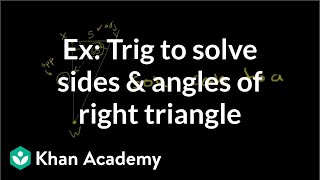
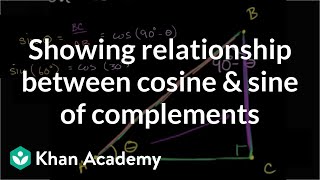
Sine & cosine of complementary angles
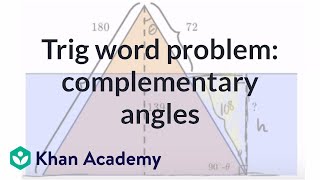
Modeling with right triangles
Unit 10: Solid geometry
2D vs. 3D objects
Cavalieri's principle and dissection methods
Volume and surface area
Unit 11: Circles
Circle basics
Arc measure
Arc length (from degrees)
Introduction to radians
Arc length (from radians)
Inscribed shapes problem solving
Proofs with inscribed shapes
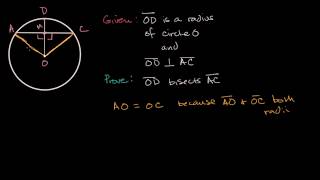
Properties of tangents
 Proof: Radius is perpendicular to tangent line ✓ Check-ins8:41
 Proof: Segments tangent to circle from outside point are congruent ✓ Check-ins3:56
 Tangents of circles problem (example 1) ✓ Check-ins4:37
 Tangents of circles problem (example 2) ✓ Check-ins3:47
 Tangents of circles problem (example 3) ✓ Check-ins2:34
Constructing regular polygons inscribed in circles
Constructing circumcircles & incircles
Constructing a line tangent to a circle
Unit 12: Conic sections
Introduction to conic sections
Features of a circle
Standard equation of a circle
Expanded equation of a circle
Unit 13: Probability
Probability basics
 Intro to theoretical probability ✓ Check-ins8:18
 Simple probability: yellow marble ✓ Check-ins2:56
 Simple probability: non-blue marble ✓ Check-ins9:56
 Experimental probability ✓ Check-ins6:55
 Theoretical and experimental probabilities ✓ Check-ins7:02
 Making predictions with probability ✓ Check-ins5:05
 Intuitive sense of probabilities ✓ Check-ins8:51
 Probability models example: frozen yogurt ✓ Check-ins7:25
Counting with combinations
Probability with counting, permutations, combinations
Multiplication rule for independent events
Multiplication rule for dependent events
Addition rule for probability
Learn this with a class
With a class on Puzzicle this course runs as a timetable of live study parties: your batch watches together and answers the check-ins, sometimes with a teacher leading.
Course content © Khan Academy, used under CC BY-NC-SA. See this course on Khan Academy.